 how-to
How Long Do Used SUVs Last? Miles and Years
Last Updated: November 1, 2026
Quick Summary
Many well-built used SUVs run past 200,000 miles with regular maintenance, and some reach 250,000 miles or more. Lifespan depends on how the vehicle was driven and cared for, not just its odometer reading. Service records and a pre-purchase inspection matter more than the number on the dash.
- Mileage is a useful guide, but it does not predict failure on its own.
- Highway miles are generally easier on an SUV than city, towing, or severe-use miles.
- Around 100,000 miles, check belts, hoses, spark plugs, and fluid services.
- Past 150,000 miles, inspect suspension and cooling system parts closely.
- Get a pre-purchase inspection and review maintenance records before buying.
Table of Contents
- How Long a Used SUV Typically Lasts in Miles and Years
- How Mileage Affects a Used SUV's Remaining Life
- What Is Considered High Mileage for an SUV
- Why Maintenance History Matters More Than the Odometer
- Reliability Differences Between Models and Powertrains
- Used SUV Inspection Checklist for Mileage and Age
- Before you touch the vehicle: records and history
- Engine and underhood checks (all mileages, heavier emphasis past 100,000)
- Transmission and drivetrain (especially past 150,000)
- Suspension, steering, and brakes (heavier emphasis past 150,000)
- Rust and body (age-driven, not mileage-driven)
- Tires and wheels
- Road test
- Independent pre-purchase inspection
- Estimating Your Next Used SUV's Remaining Life Before You Buy
- Frequently Asked Questions
How Long a Used SUV Typically Lasts in Miles and Years
How long do used SUVs last? With regular maintenance, many well-built SUVs run well past 200,000 miles, and some reach 250,000 miles or more.
Think of an SUV's lifespan as a range, not a fixed date. Age and mileage set the starting point.
Key points to keep in mind:
- Mileage is a useful guide, but it is not the whole story
- A well-kept SUV can outlast a neglected one with fewer miles
- Engine and drivetrain quality often decide how long a vehicle lasts
Lifespan depends on more than mileage alone, so the table below summarises the key reference points from the article.
| Factor | Typical point | Note |
|---|---|---|
| Well-maintained SUV | Past 200,000 miles | Many well-built SUVs reach this |
| Top end of range | 250,000 miles or more | Requires regular maintenance |
| High mileage | Above 100,000 miles | Price and inspect accordingly |
| Caution threshold | Around 150,000 miles | Some buyers grow more cautious here |
| Highway miles | Generally easiest on SUV | Steady speed, light brake use |
| Towing miles | Hardest on SUV | Raises engine and transmission heat |
How Mileage Affects a Used SUV's Remaining Life
Mileage tells you how much wear the moving parts have seen. Engines, transmissions, suspension joints, and brakes all wear with use. The more miles, the less life is usually left in those parts.
But mileage alone does not predict failure. A 150,000-mile SUV with careful service records may be in better shape than a 90,000-mile vehicle that was never maintained.
Why identical mileage can mean different wear
Mileage is a count of distance, not a count of stress. The same 100,000 miles can be accumulated in very different ways:
- Highway miles are generally the easiest on an SUV. The engine stays at steady speed, the transmission shifts less, brakes are used lightly, and the suspension cycles gently. A 120,000-mile highway vehicle often has more life left than an 80,000-mile city vehicle.
- City and stop-and-go miles are harder. Frequent cold starts, constant shifting, heavy brake use, and short trips that never fully warm the engine all accelerate wear on the engine, transmission, brakes, and exhaust.
- Towing and hauling miles are the hardest of all. Towing raises engine and transmission temperatures, stresses the cooling system, and wears brakes and suspension faster. A tow-rated SUV that spent its life pulling a trailer can be significantly more worn than its odometer suggests.
A practical rule: ask how the vehicle was driven, not just how far. A one-owner SUV with highway commuting records is a different proposition from a former fleet or rental vehicle with the same mileage.
Mileage milestones to plan around
Use these as checkpoints, not expiration dates. They tell you where to look and what to budget for.
- 100,000 miles: Many owners start planning for belts, hoses, spark plugs, and fluid services. This is also when the first major scheduled maintenance items, timing belt on interference engines, coolant flush, transmission fluid service, often come due if they were not done earlier.
- 150,000 miles: Suspension and cooling system parts often need attention. Struts and shocks, control-arm bushings, ball joints, tie-rod ends, water pumps, and radiators are common replacement items in this range. Brake calipers and wheel bearings may also need service.
- 200,000 miles: Major components like the transmission deserve close inspection. Engine mounts, catalytic converters, and the timing chain or belt (depending on the engine) are worth reviewing. At this point, the service history matters more than the number itself.
Mileage is a useful guide, but it is not the whole story. The next sections show how to weigh it against maintenance history, model reliability, and a hands-on inspection.
What Is Considered High Mileage for an SUV
High mileage for an SUV is generally considered anything above 100,000 miles. Some buyers treat 150,000 miles as the point where caution increases.
Still, the number itself is only a starting point. A high-mileage SUV with steady highway miles often has less wear than a low-mileage one that has spent years on short, stop-and-go trips.
Is high mileage a deal-breaker? Not always. Price the vehicle to reflect its condition, and get a pre-purchase inspection before you decide.
Why Maintenance History Matters More Than the Odometer
Service records tell you what the odometer cannot. Regular oil changes, fluid flushes, and timely repairs signal that someone looked after the vehicle. Maintenance schedule for older vehicles lists the service intervals that keep an older vehicle running.
Ask for maintenance records whenever possible. Look for:
- Regular oil changes at the recommended intervals
- Transmission and coolant service
- Documented brake and suspension repairs
Without records, a vehicle's history is harder to trust. That uncertainty is a reason to lean on a thorough inspection.
Reliability Differences Between Models and Powertrains
Not every SUV ages the same way. Model design, engine type, and transmission all affect long-term durability.
Some SUV models have a reputation for holding up well over many years. Others have known issues that appear at higher mileage. Research the specific model year you are considering, including any recalls or common problems reported by owners.
Powertrain choices matter too. Simpler, proven engine and transmission combinations tend to age more predictably than newer, more complex designs.
Used SUV Inspection Checklist for Mileage and Age
A generic checklist tells you what to look at. A mileage- and age-tied checklist tells you what to expect and what to budget for. Use the framework below to turn general lifespan advice into specific checks for the engine, transmission, suspension, rust, tires, and service records.
Before you touch the vehicle: records and history
- Vehicle history report, Check for accidents, title brands (salvage, rebuilt, flood), odometer rollback, and ownership history. A one-owner vehicle with consistent registration in one region is usually easier to trust than a vehicle that changed hands several times in a short period.
- Maintenance records, Look for regular oil changes at the recommended intervals, transmission and coolant service, brake and suspension work, and any major repairs. Missing records are not automatically disqualifying, but they shift more weight onto the physical inspection.
- Open recalls, Check the manufacturer's recall lookup using the VIN. Verify a vehicle's history report shows how to confirm mileage and accident history. Unrepaired safety recalls are a negotiating point and a safety concern.
Engine and underhood checks (all mileages, heavier emphasis past 100,000)
- Oil condition and level, Dark, gritty oil or a low level can signal neglect. Milky or frothy oil can indicate a coolant leak into the engine.
- Coolant condition, Rusty or sludgy coolant suggests the cooling system was neglected. Check for leaks at the radiator, hoses, and water pump.
- Belts and hoses, Look for cracks, glazing, and soft spots. Past 100,000 miles, ask whether the timing belt (if equipped) was replaced.
Transmission and drivetrain (especially past 150,000)
- Transmission fluid, Check color and smell. Burnt-smelling or dark fluid can indicate overheating or deferred service.
- Shift quality, On the road test, note delayed engagement, slipping, harsh shifts, or shuddering. These are often expensive to fix.
- Drivetrain noises, Clunks on acceleration or deceleration can point to worn mounts, U-joints, or CV joints. On all-wheel-drive and four-wheel-drive models, confirm the transfer case and differential fluids were serviced.
Suspension, steering, and brakes (heavier emphasis past 150,000)
- Struts and shocks, Look for leaking fluid, and note excessive bounce or float on the road test.
- Ball joints, tie-rod ends, and bushings, Check for play, torn boots, and cracking. These are common wear items in the 150,000-mile range.
- Brakes, Check pad thickness, rotor condition, and brake line condition. Uneven wear can signal a sticking caliper.
- Steering, Note play, pulling, or unusual noises.
Rust and body (age-driven, not mileage-driven)
- Underbody rust, Check frame rails, floor pans, rocker panels, and brake lines. Surface rust is common; flaking, perforation, or rust around structural mounts is a serious concern.
- Body panel alignment, Uneven gaps can indicate prior accident repair.
- Water intrusion, Check carpets, spare-tire wells, and door seals for dampness or musty smells.
Tires and wheels
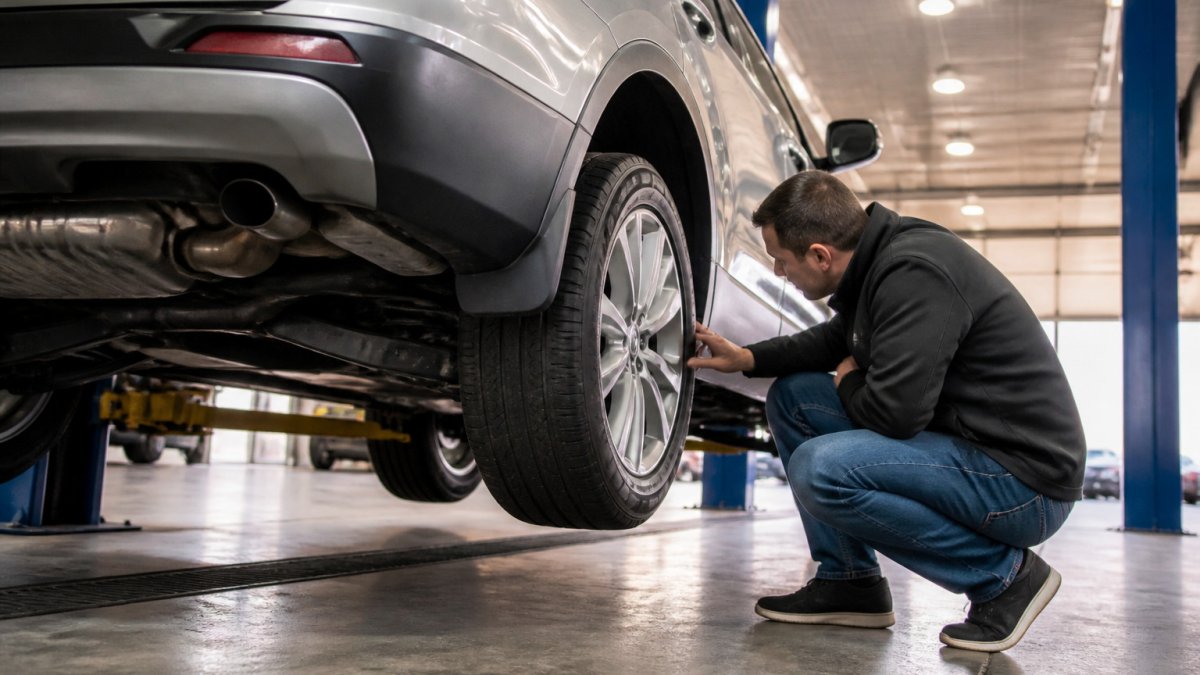
- Tread depth and evenness, Uneven wear can signal alignment or suspension problems. Check the date code on the sidewall; tires older than six years should be replaced regardless of tread.
- Matching set, Mismatched brands or sizes can indicate budget repairs or neglect.
Road test
- Cold start, Listen for unusual noises and watch for smoke.
- Acceleration and shifting, Note hesitation, slipping, or harsh shifts.
- Braking, Check for pulsation, pulling, or noise.
- Steering and suspension, Note wander, vibration, or clunks over bumps.
Independent pre-purchase inspection
- Hire an independent mechanic, A pre-purchase inspection is one of the best ways to catch problems a test drive misses. Ask for a compression or leak-down test on higher-mileage engines, and a scan for stored diagnostic trouble codes.
Mileage and age tell you where to look. The inspection tells you what is actually there, and the records tell you how well it was cared for along the way. Full used SUV buying guide covers what else to check on a used SUV.
Estimating Your Next Used SUV's Remaining Life Before You Buy
To estimate remaining life, combine several factors: current mileage, age, service history, and the results of your inspection.
Also consider your own driving. Highway miles are generally easier on an SUV than heavy city driving or frequent towing.
Before you buy, weigh the repair costs you might face against the price. Set a repair budget, and walk away if the expected repairs outweigh the savings.
Browse our inventory of used SUVs, trucks, and sedans at Carvibe Houston. Our team can walk you through vehicle condition and help you find a model that fits your budget and needs. Houston used SUV buyer's guide covers buying one locally. Search
Frequently Asked Questions
How long do used SUVs typically last?
A well-maintained used SUV commonly reaches 150,000 to 200,000 miles, and many models pass 250,000 miles with consistent oil changes, timely fluid service and prompt attention to worn brakes, suspension and cooling system parts. Lifespan depends far more on how the vehicle was cared for than on its model year alone. Before buying, ask for maintenance records and a vehicle history report, then use the mileage as one data point rather than a verdict.
Can a used SUV last 250,000 miles?
Yes, many SUVs reach 250,000 miles, particularly those with documented oil changes, transmission fluid service and regular inspections of suspension, brakes and cooling components. Reaching that point usually depends on whether major repairs were handled on time. A high-mileage SUV with a complete service history can be a better buy than a lower-mileage vehicle with unknown upkeep.
Does maintenance matter more than mileage when buying a used SUV?
In many cases, yes. Two SUVs with the same odometer reading can have very different remaining life if one received regular oil, coolant and transmission service and the other did not. Maintenance records show whether wear items were replaced before they caused damage. Pair those records with a pre-purchase inspection to confirm the vehicle's actual mechanical condition.
How can I tell if a used SUV has been well maintained?
Ask the seller for maintenance records, receipts and any dealer or independent shop invoices. Look for consistent oil changes, timely belt and coolant service, and transmission fluid changes. Check that the odometer readings on service records make sense over time. Gaps in history are not automatically disqualifying, but they justify a more thorough inspection and a lower offer.