 ultimate-guide
The Essential Car Maintenance Schedule for Older Vehicles
Last Updated: October 27, 2026
Quick Summary
An essential car maintenance schedule for older vehicles combines mileage bands with calendar-based checks, because age drives wear as much as distance. Change oil every 3,000-5,000 miles or twice a year, inspect brakes and tires every six months, and replace belts, hoses, and batteries on a fixed schedule past 100,000 miles.
- Check brakes every 6 months and tires monthly as top safety priorities.
- Change oil every 3,000-5,000 miles, or every six months if you drive fewer.
- Flush brake fluid every 2-3 years because it absorbs moisture.
- Past 100,000 miles, replace belts, hoses, spark plugs, and the battery on a fixed schedule.
- Treat tires past roughly six to eight years as suspect regardless of tread.
Table of Contents
- Why Older Vehicles Need a Different Maintenance Schedule
- Your Older Car Maintenance Checklist at a Glance
- Car Maintenance Schedule by Mileage for High-Mileage Cars
- How Often to Change Oil in an Older Car
- The Car Fluid Maintenance Checklist for Aging Engines
- Brakes, Tires, and Safety Systems: What to Inspect First
- Rubber, Rust, and Age-Related Deterioration to Watch For
- Book Your Older Vehicle Inspection at Carvibe Houston
- Frequently Asked Questions
Why Older Vehicles Need a Different Maintenance Schedule
An essential car maintenance schedule for older vehicles differs from the factory plan because age, not just mileage, drives wear.
The owner's manual was written for a car in its prime, assuming average use and fresh components.
Below is a practical schedule organized by mileage, age, and how you actually drive, covering the systems that fail first on high-mileage cars plus the age-related deterioration most guides skip.
Your Older Car Maintenance Checklist at a Glance
Use this checklist as a triage tool: safety items first, then fluids, then wear parts.
| Priority | System | What to Check | How Often |
|---|---|---|---|
| 1 - Safety | Brakes | Pads, rotors, fluid, lines | Every 6 months |
| 1 - Safety | Tires | Pressure, tread depth, sidewalls | Monthly |
| 1 - Safety | Lights and wipers | Function and clarity | Monthly |
| 2 - Protection | Engine oil and filter | Level, color, change date | Every 3,000-5,000 miles |
| 2 - Protection | Coolant | Level, condition, hoses | Every 6 months |
| 2 - Protection | Transmission fluid | Level, color, smell | Every 15,000 miles |
| 3 - Reliability | Battery and charging | Voltage, terminals, alternator | Every 6 months |
| 3 - Reliability | Belts and hoses | Cracks, glazing, softness | Every oil change |
| 3 - Reliability | Spark plugs and air filter | Condition, gap, restriction | Per schedule below |
For a broader plan you can compare against this older-vehicle list, see our used car maintenance schedule guide.
Car Maintenance Schedule by Mileage for High-Mileage Cars
A car maintenance schedule by mileage for a high-mileage vehicle has to be read alongside age and driving style. A 12-year-old car with 80,000 highway miles and one with 80,000 miles of short trips need different attention despite identical odometers. Use the bands below as a baseline, then adjust for the usage modifiers that follow.
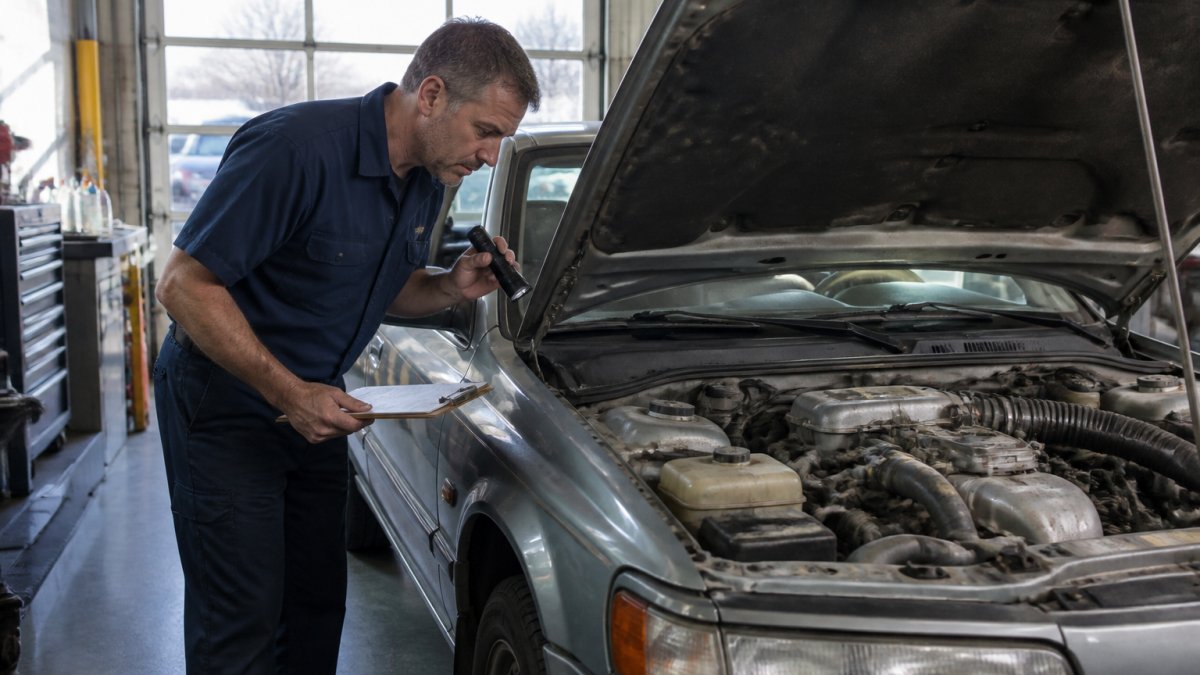
Intervals Under 100,000 Miles
At this stage, stay ahead of normal wear and catch the first age-related failures before they cascade.
- Engine oil and filter: every 3,000-5,000 miles, or twice a year if you drive fewer miles than that. Older engines dilute oil faster on short trips.
- Brake pads and rotors: inspect every 6 months or 6,000 miles; replace pads before the backing plate contacts the rotor. Rotor thickness should be measured, not eyeballed.
- Tires: rotate every 5,000-7,500 miles, check pressure monthly, and measure tread depth with a gauge. Look for sidewall cracking that appears with age even when tread remains.
- Transmission fluid: service every 30,000-60,000 miles, following the manufacturer's specified fluid and procedure. Some older units are sensitive to the wrong fluid.
- Air filter: replace every 15,000-30,000 miles, or more often in dusty conditions.
- Coolant: check level and condition every 6 months; a flush typically lands around the 60,000-100,000 mile mark, or sooner if the coolant looks rusty or cloudy.
- Spark plugs: replace at the interval for the plug type in the engine; older copper plugs wear faster than iridium.
- Belts and hoses: inspect at every oil change. A belt showing glazing or multiple cracks is due, regardless of miles.
- Battery and charging system: test the battery and check terminals every 6 months. Batteries fail on age as much as use.
Intervals Past 100,000 and 150,000 Miles
Past 100,000 miles, shift from inspection to replacement on wear items: belts, hoses, spark plugs, and the battery move to a fixed schedule. Timing belts are a hard deadline, since a snapped belt can destroy the engine; timing chains last longer but still need inspection for stretch and guide wear. Leaks become the main enemy, so check fluid levels weekly and look for drips.
- 100,000-150,000 miles: replace the timing belt if the engine has one and the interval is due; replace spark plugs and wires or coils as specified; service transmission fluid if it has not been done; inspect suspension bushings, ball joints, and tie rods for play and cracking; check brake lines and fuel lines for corrosion.
- 150,000 miles and beyond: expect to replace the radiator, water pump, alternator, and starter as preventive items rather than waiting for failure; inspect engine mounts and exhaust hangers; check the catalytic converter and oxygen sensors if fuel economy drops or a check-engine light appears; recheck every rubber component on the car, including weatherstripping and vacuum lines.
Usage Modifiers That Change the Schedule
Mileage alone is a blunt instrument. Adjust the baseline for actual use:
- Short trips and stop-and-go driving: shorten oil changes toward the 3,000-mile end, check the battery more often, and watch for moisture in the oil and exhaust. The engine never reaches full temperature, so condensation and fuel dilution accelerate wear.
- Extreme heat or cold: check coolant, battery, and tire pressure more frequently. Heat ages rubber and fluid; cold stresses batteries and thickens fluids.
- Dusty or coastal environments: replace air filters sooner and inspect underbody and brake lines for corrosion more often.
For a broader plan you can compare against this older-vehicle list, see our used car maintenance schedule guide.
How Often to Change Oil in an Older Car
Change the oil in an older car every 3,000-5,000 miles, or every six months if you drive fewer. Aging engines burn and leak oil faster, and worn piston rings let more combustion byproducts into the crankcase. Short trips worsen it: the engine never reaches full temperature, so moisture and fuel dilute the oil.
A common mistake is stretching oil changes to the manufacturer's original long interval, which assumes a tight engine you no longer have. Check the dipstick weekly and top off between changes. If you are deciding between oil types, the synthetic vs conventional oil cost comparison breaks down the trade-off for an aging engine.
The Car Fluid Maintenance Checklist for Aging Engines
The car fluid maintenance checklist for an older vehicle covers six fluids: engine oil, coolant, transmission fluid, brake fluid, power steering fluid, and washer fluid. Each one degrades on a time interval, not just mileage.
- Coolant: Check level and color every 6 months. A coolant flush removes contaminants and restores corrosion protection, typically every 30,000-50,000 miles on an older car.
- Transmission fluid: Check every 15,000 miles. Dark, burnt-smelling fluid signals heat and wear.
- Brake fluid: Flush every 2-3 years. Brake fluid absorbs moisture, which lowers its boiling point and corrodes the system from inside.
Watch out: ignoring a slow coolant leak is the fastest way to turn a cheap hose replacement into a head gasket repair.
Brakes, Tires, and Safety Systems: What to Inspect First
Inspect brakes and tires first, because they fail without warning. On an older vehicle, the more useful question is how to triage what you find: a worn pad and a corroded brake line are both brake problems, but one can wait a few weeks and the other should not be driven. The framework below separates immediate safety repairs from preventive work you can schedule.
Triage by Urgency
Stop driving and repair immediately:
- Brake pedal that sinks or feels spongy, or a brake warning light that stays on.
- Visible brake fluid leak, or fluid level dropping between checks.
- A brake line that is wet, blistered, or heavily rusted.
Schedule within the next few weeks:
- Pads at or near the wear indicator, or rotors with deep scoring or a pronounced lip.
- Tires at or near the tread wear indicator (2/32 inch) or showing uneven wear.
- A battery that tests marginal or terminals with heavy corrosion.
Monitor at each inspection:
- Slight brake pedal travel that is stable over time.
- Minor surface rust on underbody components that is not flaking or perforated.
- Slow fluid seeps that are not yet leaving drips.
Brakes
A brake inspection should cover pad thickness, rotor condition and thickness, brake lines, hoses, calipers, and fluid. Measure pad friction material with a gauge rather than by eye, and check flexible hoses for cracking and hard lines for rust, especially along the underbody and near the fuel tank. For the warning signs, see the guide to the signs of worn brake pads.
Tires
Check pressure monthly with a gauge, measure tread depth, and examine sidewalls for cracks and bulges. On older vehicles, watch tire age as well as tread: rubber hardens and sidewalls crack even when tread looks fine. Check the DOT date code and treat tires past roughly six to eight years as suspect regardless of tread. Rotate for even wear, and align after any suspension work.
Rust and Underbody Inspection
Rust is the safety issue most general maintenance guides skip, and it matters most on older cars. Inspect the underbody, rocker panels, floor pans, subframe, and suspension mounting points, paying particular attention to brake and fuel lines, which can rust from the outside in and fail suddenly. A line that is damp, blistered, or flaking is a stop-driving item. Tight, non-perforated surface rust can be monitored and treated; flaking, perforated, or structural rust needs professional evaluation.
Charging, Lights, and Visibility
On older vehicles, also check the charging system: a battery test and quick alternator check at every oil change catch a failing battery before it strands you. Replace wiper blades every 6-12 months, restore cloudy headlight lenses, and confirm all exterior bulbs work.
Rubber, Rust, and Age-Related Deterioration to Watch For
Rubber and plastic parts fail on a clock, not an odometer. Belts crack and glaze, hoses soften and bulge, and bushings dry out even on a low-mileage car. Inspect belts and hoses at every oil change and replace anything showing cracks or softness.
Rust is the other silent killer: check the underbody, rocker panels, and brake lines, especially on cars exposed to road salt or coastal air. A dying battery is another age-related failure, the guide to the signs a car battery is dying covers what to look for.
Book Your Older Vehicle Inspection at Carvibe Houston
Keeping an aging car on the road comes down to triage: fix safety items first, protect the engine second, and replace wear parts before they fail. A documented schedule turns guesswork into a plan.
At Carvibe Houston, our expert technicians provide reliable auto maintenance and repair services. If you want to compare options first, see this list of affordable auto repair shops in Houston.
Frequently Asked Questions
How often should you service an older car?
Most older vehicles need an inspection every 6 months or 6,000 miles, whichever comes first. If you drive in stop-and-go traffic, take short trips, or tow, shorten that to every 3,000 to 5,000 miles. The owner's manual lists the manufacturer recommendations, but age and wear mean you should check belts, hoses, and fluids more often than the manual suggests for a new car.
What should be included in an older car maintenance checklist?
A solid older car maintenance checklist covers engine oil and filter, coolant level and condition, transmission fluid, brake fluid, tire pressure and tread, battery and charging system, belts and hoses, spark plugs, air filter, wiper blades, and lights. Add a visual underbody inspection for rust and leaks. Keep maintenance records for every service so you can spot recurring issues and plan a budget.
How often should you change the oil in an older vehicle?
For most older cars, change conventional oil every 3,000 to 5,000 miles and full synthetic every 5,000 to 7,500 miles. High-mileage engines burn or leak oil faster, so check the dipstick monthly and top off as needed. If your car sees mostly short trips or heavy traffic, stay at the lower end of that range.
When should you replace the timing belt on an older car?
Most timing belts are due between 60,000 and 100,000 miles, or every 6 to 10 years. Because a snapped belt can destroy the engine, replace it on the earlier of the mileage or time interval, even if it looks fine. Cars with a timing chain usually need no scheduled replacement, but listen for rattling on cold starts and have it inspected.
Should older cars follow the maintenance schedule in the owner's manual?
Use the owner's manual as a baseline, then adjust for age and use. Rubber parts, fluids, and plastic components degrade with time even at low mileage. A 15-year-old car with 60,000 miles may need belts, hoses, and coolant service sooner than the mileage table suggests. Combine the manual's mileage intervals with time-based checks for the best coverage.
Your older car is only as dependable as the schedule behind it. Whether you need a thorough inspection or you are ready to trade toward something newer, Carvibe Houston is here to help with expert maintenance, flexible financing, and fair trade-in values. Get started with Carvibe Houston and drive with confidence.