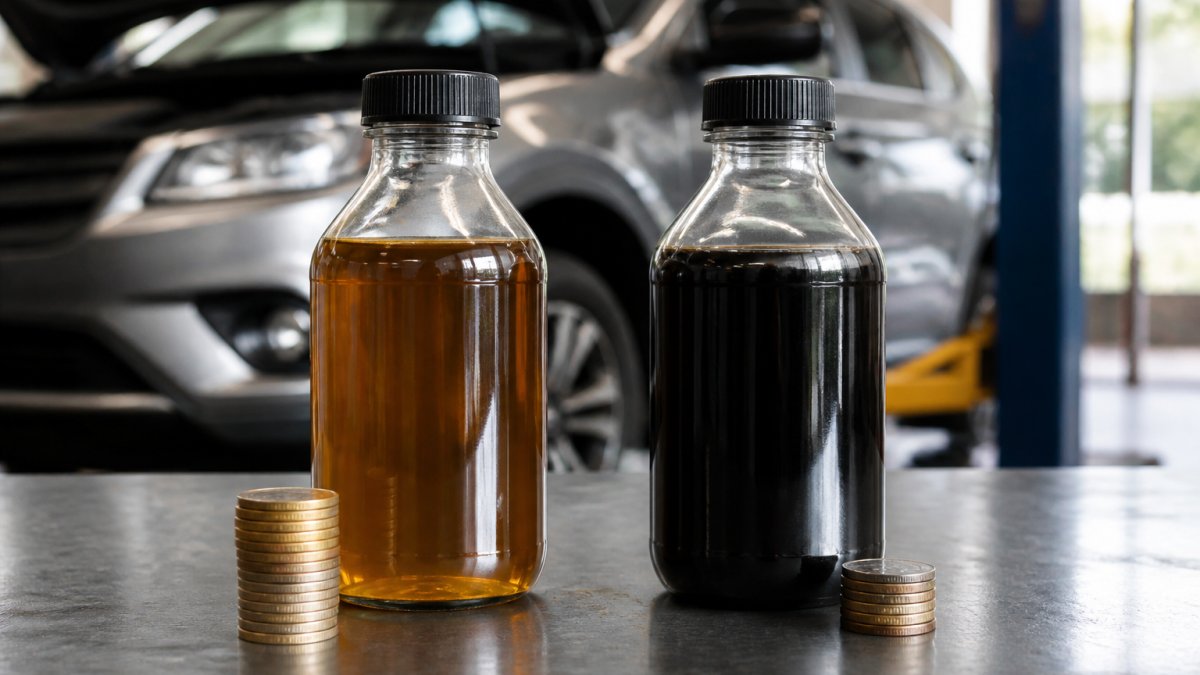
 comparison
Synthetic vs Conventional Oil: Cost Comparison 2026
Table of Contents
- What Conventional Motor Oil Is
- What Synthetic Motor Oil Is
- Synthetic Oil Change Cost vs Conventional Oil Change Cost
- How Often to Change Synthetic Oil vs Conventional
- Total Cost Over Time: DIY vs Professional Service
- Is Synthetic Oil Worth It for Your Vehicle
- Engine Protection and Performance Differences
- What Your Owner's Manual Actually Requires
- Frequently Asked Questions
Last Updated: October 7, 2026
What Conventional Motor Oil Is
Conventional motor oil is refined crude oil with additives to protect your engine, and understanding synthetic vs conventional oil cost is key to choosing the right product for your budget.
It works well for older engines designed around it, but breaks down faster under heat and stress, so drain intervals are shorter.
Most conventional oils are rated by viscosity grade, like 5W-30 or 10W-40: the first number indicates cold-start flow, the second protection at operating temperature.
What Synthetic Motor Oil Is
Synthetic motor oil is artificially engineered oil created from chemical compounds rather than refined crude. It's manufactured to precise specifications, meaning fewer impurities and more consistent performance across temperature ranges.
Full synthetic resists oxidation better, flows more smoothly when cold, and maintains viscosity better at high temperatures.
Synthetic blend mixes conventional and synthetic base stocks: cheaper than full synthetic, better than straight conventional.
Synthetic Oil Change Cost vs Conventional Oil Change Cost
The upfront service cost difference is significant, and synthetic vs conventional oil cost varies considerably depending on where you service your vehicle. According to CarMatcher's 2026 U.S. price guide, conventional oil changes average between $35 and $75, while synthetic oil changes typically run $65 to $125. That's roughly double the cost at point of service.

Upfront Service Pricing
At a shop you pay labor plus oil. Labor is roughly the same either way, usually $20 to $40 depending on vehicle and location; the oil product is the difference.
A quart of conventional costs far less than synthetic. AutoZone notes a full-synthetic upgrade to an oil-change service costs around $45 to $100, reflecting the premium oil and sometimes extra labor.
Cost Per Quart Breakdown
Conventional oil typically costs $3 to $8 per quart; synthetic runs $8 to $15, with premium synthetics exceeding $15.
Most vehicles hold 4 to 6 quarts. Conventional oil might cost $15 to $35; synthetic for the same vehicle could be $40 to $80, and the spread widens with premium brands.
Per-quart cost matters most for DIY changes; at a shop, service pricing matters more.
How Often to Change Synthetic Oil vs Conventional
Conventional oil typically requires changes every 3,000 to 5,000 miles; synthetic can often stretch to 7,500 to 10,000 miles or beyond, depending on vehicle and driving conditions.
Your owner's manual is the source of truth.
Severe conditions, short trips, towing, dust, shorten intervals for both types, while steady highway driving maximizes them.
This interval difference is crucial: if synthetic lets you go twice as long between changes, the higher per-service cost spreads across more miles.
Total Cost Over Time: DIY vs Professional Service
The real question is which oil costs less per mile and per year of ownership. To answer honestly, separate the four cost inputs, oil, filter, labor, and services per year, and change one variable at a time. Most comparisons quote only a per-service price, which is why both "synthetic costs more" and "synthetic pays for itself" can sound true.
The Four Inputs You Need to Compare Like for Like
- Oil volume and price per quart. Most four-cylinder and V6 engines hold 4 to 6 quarts; many V8s and diesels hold 6 to 8. Multiply capacity by per-quart price.
- Filter price. Both oil types use the same filter in most applications, commonly $6 to $15 at retail. This cost is essentially identical, so it cancels out of the comparison.
- Labor or your own time. A shop typically charges $20 to $40, sometimes bundled into a flat price. DIY labor is free in dollars but costs 30 to 60 minutes plus disposal.
- Services per year. This variable decides the outcome. It depends on annual mileage and the manufacturer's specified interval, not oil type alone.
A Worked Example at 12,000 Miles per Year
Assume a vehicle holding 5 quarts, using a $10 filter, driven 12,000 miles per year. Plug in your own numbers.
DIY, conventional at a 5,000-mile interval:
- 12,000 ÷ 5,000 = 2.4, so 3 services per year (you round up because you can't do a partial change)
- Oil: 5 quarts × $5 = $25 per service
- Filter: $10 per service
DIY, full synthetic at a 7,500-mile interval:
- 12,000 ÷ 7,500 = 1.6, so 2 services per year
- Oil: 5 quarts × $10 = $50 per service
- Filter: $10 per service
Here synthetic costs about $15 more per year in DIY parts, a modest premium, not the doubling the per-service price suggests.
Shop service, same assumptions plus $30 labor:
- Conventional: 3 × ($35 + $30) = $195 per year
- Synthetic at 7,500 miles: 2 × ($60 + $30) = $180 per year
Here the labor savings from one fewer visit flips the result: synthetic comes out slightly cheaper. This only holds when the interval actually lengthens and labor is meaningful.
Why the Break-Even Moves Around
The break-even point is sensitive to three things:
- Interval ratio. Going 1.5× as far saves one-third of your services; 1.2× saves almost nothing.
- Labor share of the bill. The higher the labor component, the more a skipped visit is worth. DIYers get the smallest financial benefit from longer intervals, their savings are mostly time, not money.
- Per-quart spread. At $4/quart conventional versus $12/quart synthetic, oil cost triples; at $5 to $8, it barely moves the total.
What to Do With This
Run the four inputs for your own vehicle. The two numbers that matter most are your manufacturer's specified interval and your annual mileage. If your manual caps the interval at 5,000 miles, the cost case for synthetic is about protection, not savings. If it allows 7,500 to 10,000 miles with synthetic and you drive enough to hit those intervals, shop labor savings can offset the premium.
Is Synthetic Oil Worth It for Your Vehicle
This depends on three factors: your vehicle's design, your driving habits, and how long you plan to keep the car.
When Synthetic Makes Sense
Newer vehicles engineered for synthetic benefit most.
Consistent highway drivers save time and shop visits with synthetic's longer intervals, real value in changing oil half as often.
If you keep vehicles seven years or more, cumulative labor savings add up, and you schedule fewer shop visits.
Severe conditions, towing, short trips, dust, make synthetic worthwhile because it resists breakdown better under stress, keeping the engine cleaner longer.
When Conventional Is the Right Choice
Older vehicles designed for conventional don't benefit from switching. The engine wasn't engineered around synthetic's properties, so you pay premium prices without gaining longer intervals.
If you're selling within two years, conventional is pragmatic, you won't recoup the synthetic premium before ownership changes.
Short-trip local driving doesn't stress oil enough to demand synthetic; conventional handles it adequately.
Budget-conscious drivers with older vehicles often find conventional cheaper per service and sufficient, a legitimate choice.
Engine Protection and Performance Differences
Synthetic oil provides measurably better protection under extreme conditions. It resists oxidation far longer, meaning less sludge buildup and cleaner internals over time.
Cold-start protection favors synthetic: in winter it flows more readily, circulating faster when the engine fires up.
Heat resistance also favors synthetic.
For normal city driving in moderate climates, though, the protection difference rarely shows up as a tangible problem with conventional oil.
What Your Owner's Manual Actually Requires
Your owner's manual is the specification your vehicle was engineered around. But "specification" means more than a viscosity grade, and understanding the full picture separates a compliant oil change from one that could complicate a warranty claim.
The Three Things a Manual Actually Specifies
- Viscosity grade. The familiar 0W-20, 5W-30, 5W-20, 10W-30, and so on. The first number describes cold-weather flow (lower is thinner when cold), the second thickness at operating temperature. The wrong grade can affect fuel economy, oil pressure, and variable valve timing.
- Performance specification. Most drivers overlook this. It appears as an API service category (API SP or API SN), an ILSAC GF designation (ILSAC GF-6A), or an OEM approval like GM dexos1, Ford WSS-M2C946, or Chrysler MS-6395. These describe the additive package and test performance the engine was validated against, not just the base oil.
- Oil type language. The manual may say "synthetic required," "synthetic recommended," "full synthetic," "synthetic blend acceptable," or say nothing and simply list a viscosity and performance spec.
How to Read the Language
- "Synthetic required" or "must use full synthetic." No flexibility. Using conventional risks non-compliance.
- "Synthetic recommended" or "for best performance, use synthetic." Conventional meeting the viscosity and performance spec is generally acceptable, but you give up the longer interval validated for synthetic.
- Viscosity and performance spec only, no oil type mentioned. You have flexibility on base oil but must still meet the viscosity grade and API/ILSAC/OEM spec. Most common in older manuals.
The Warranty Mechanics
Oil type alone doesn't determine warranty compliance. What matters is whether the oil met the manufacturer's published specification for your engine and whether you changed it within the specified interval. A lubrication-related warranty claim typically triggers a request for maintenance records, receipts showing oil used, date, and mileage. If those show an oil that didn't meet spec, or intervals exceeding the manual's limit, that's the exposure.
A few practical points:
- Keep receipts. Date, mileage, oil brand and product line, and the spec printed on the bottle.
- If you DIY, note the filter part number; some manufacturers specify a particular filter.
- If a shop does the work, the invoice should list the oil used; ask them to print the spec if it isn't there.
Oil-Life Monitoring Systems
Many vehicles built in the last 15 years use an oil-life monitor calculating remaining life from engine hours, temperature cycles, trip length, and other inputs. Its percentage is a countdown, not a guarantee. Two caveats:
- The monitor assumes the correct oil was used. If the manual specifies synthetic and you used conventional, its estimate may not reflect the oil's actual condition.
- The manual usually states a maximum interval regardless of the monitor, often 10,000 or 12,000 miles, or one year. Whichever comes first governs.
What This Means for Your Choice
If your manual requires a specific OEM approval, your choice is constrained to products carrying it, usually synthetic or blend. If it lists only a viscosity and API/ILSAC spec, you have real flexibility, and the cost comparison above decides. If it's silent on oil type and specifies a short interval, conventional meeting the spec is legitimate. The manual, not the bottle label, is the authority.
Frequently Asked Questions
How much more does synthetic oil cost than conventional oil per oil change?
A synthetic oil change typically costs $65-$125, while conventional oil changes average $35-$75, making synthetic roughly $30-$50 more per service. The exact premium depends on your vehicle, local labor rates, and whether you choose full synthetic or a synthetic blend. For a realistic estimate, contact a local shop for a quote on your specific vehicle.
Do you really need to change synthetic oil every 5,000 miles?
No. Most vehicles with full synthetic oil can go 7,500 to 10,000 miles between changes, and some newer models approve intervals up to 15,000 miles. Conventional oil typically requires changes every 3,000 to 5,000 miles. Always check your owner's manual for the manufacturer's recommended drain interval, following it protects your warranty and engine.
Is synthetic oil worth the extra cost over time?
It depends on your driving habits and vehicle age. Synthetic oil's longer drain intervals and superior engine protection can offset its higher upfront cost over the life of your vehicle, especially for newer cars or those driven in severe conditions. Older vehicles with high mileage or light, infrequent driving may see less benefit. Calculate your total annual cost based on your specific drain interval and local service prices.
Can I switch from conventional oil to synthetic oil in my car?
Yes, you can switch to synthetic oil in most vehicles. However, check your owner's manual first, some older engines or those with high mileage may have specific oil requirements. If you've been using conventional oil, synthetic won't clean out existing sludge, so a thorough oil change is important. Once switched, you can continue using synthetic for longer drain intervals.