 comparison
Are Used Hybrid SUVs Worth It?
Table of Contents
- What Makes a Used Hybrid SUV Different From a Gas SUV
- Used Hybrid SUV Pros and Cons
- Fuel Savings and Break-Even Math for Used Hybrid SUVs
- Used Hybrid SUV Battery Life, Warranty, and Replacement Costs
- Used Hybrid SUV vs Gas SUV: Total Cost of Ownership
- Used Hybrid SUV Inspection Checklist Before You Buy
- Deciding Whether a Used Hybrid SUV Fits Your Driving and Budget
- Frequently Asked Questions
Last Updated: October 29, 2026
What Makes a Used Hybrid SUV Different From a Gas SUV
A used hybrid SUV pairs a gasoline engine with one or more electric motors and a battery pack. The system shifts between power sources and recovers energy during braking. That difference changes how the vehicle uses fuel, how it ages, and what a buyer should check before purchase.
Hybrid SUVs in the used market mix several designs. Some are full hybrids that run on electricity at low speeds. Others are plug-in hybrids that can travel short distances on a charge. Carvibe Houston offers SUVs, trucks, and sedans.
The core trade-off is simple. A hybrid usually costs more at purchase but can spend less on fuel. Whether that math works depends on how many miles you drive and how long you keep the vehicle.
Used Hybrid SUV Pros and Cons
The strongest case for a used hybrid SUV is fuel economy in stop-and-go traffic, where electric assist does most of the work.
The drawbacks are real. Battery replacement is the largest single risk, and it can be expensive if the pack fails outside its warranty. Repair shops also need training for hybrid systems, which can limit where you take the vehicle for service.
Pros:
- Lower fuel use in city and highway driving
- Quieter operation at low speeds
- Regenerative braking reduces brake wear
Cons:
- Higher purchase price than comparable gas models
- Battery condition varies with age and mileage
- Specialized repairs may cost more
Fuel Savings and Break-Even Math for Used Hybrid SUVs
To judge whether a used hybrid SUV is worth it, compare the extra purchase price against the fuel you save each year. Divide the price premium by your annual fuel savings to estimate how many years it takes to break even. The method is simple; the trick is using realistic inputs instead of the window-sticker ratings.
The method, with a worked example
- Note the hybrid's and the gas SUV's combined fuel economy ratings from the EPA's fueleconomy.gov tool.
- Estimate your annual miles and your local gas price.
- Calculate the yearly fuel cost for each vehicle: annual miles ÷ mpg × gas price.
- Subtract the hybrid's yearly cost from the gas model's yearly cost.
- Divide the purchase price difference by that number.
Here is the math with round, illustrative numbers, substitute your own:
- Gas SUV at 24 mpg, hybrid SUV at 36 mpg, 12,000 miles per year, gas at $3.50 per gallon.
- Gas SUV: 12,000 ÷ 24 × $3.50 = $1,750 per year.
- Hybrid SUV: 12,000 ÷ 36 × $3.50 = $1,167 per year.
- Annual fuel savings: about $583.
- If the used hybrid carries a $3,000 price premium, break-even is roughly 5.1 years.
- If the premium is $1,500, break-even drops to about 2.6 years.
That single example shows why the answer is not universal: the same fuel savings produce a very different verdict depending on the price gap and how long you keep the car.
The inputs that move the answer most
- Annual miles. Fuel savings scale almost linearly with miles. At 6,000 miles per year the example above saves only about $292 annually and break-even stretches past a decade; at 20,000 miles it saves about $972 and break-even falls under four years.
- Gas price. Higher gas prices shorten break-even. At $5.00 per gallon the example saves about $833 per year instead of $583.
- The price premium. This is the number buyers most often get wrong. Compare actual transaction prices for similar trim, mileage, and condition, not sticker prices, because used hybrid premiums vary widely by model and by how much demand has pushed them up.
- Real-world mpg versus EPA ratings. Hybrids often beat their EPA highway rating in city driving and fall short on sustained high-speed highway runs. If most of your driving is highway, expect a smaller gap than the ratings suggest.
Beyond fuel: the other line items that decide break-even
Fuel is only part of the math. A fair break-even calculation also weighs:
- Brake wear. Regenerative braking typically extends brake pad and rotor life, which is a real but modest savings over several years.
- Insurance. Hybrid SUVs sometimes carry slightly higher premiums because of repair complexity and battery replacement exposure; get quotes on both vehicles before you decide.
- Maintenance and repairs. Routine costs are often similar, but specialized hybrid repairs can cost more and may require a dealer or a hybrid-trained independent shop.
- Resale value. Hybrids have generally held value well, but that can change as battery age becomes a bigger factor for older models.
- Any federal or state incentives. Used plug-in hybrids may qualify for a federal clean vehicle credit under current rules, but eligibility depends on the vehicle, the seller, and your income, verify before counting it.
Exact figures depend on the specific models and prices you are considering, so verify them before you decide.
The worked example below compares a gas SUV and a hybrid SUV using the same annual miles and gas price, showing how the price premium and fuel savings determine break-even.
| Input or result | Value | Note |
|---|---|---|
| Gas SUV combined mpg | 24 mpg | Illustrative figure |
| Hybrid SUV combined mpg | 36 mpg | Illustrative figure |
| Annual miles | 12,000 | Substitute your own |
| Gas price | $3.50 per gallon | Illustrative figure |
| Annual fuel savings | About $583 | Gas $1,750 vs hybrid $1,167 per year |
| Break-even with $3,000 premium | About 5.1 years | Premium divided by annual savings |
| Break-even with $1,500 premium | About 2.6 years | Smaller price gap shortens payback |
Used Hybrid SUV Battery Life, Warranty, and Replacement Costs
The hybrid battery is the component buyers worry about most, and it is also the one where generic advice fails. Most practitioners find that a well-maintained nickel-metal hydride (NiMH) pack in an older hybrid SUV commonly lasts 10 to 15 years or 150,000 to 200,000 miles before capacity drops enough to matter, while newer lithium-ion packs tend to hold up well but are more sensitive to heat. Capacity loss is gradual, not a sudden failure, a pack at 70% of its original capacity still works, it just delivers less electric assist and lower fuel economy.
What actually shortens battery life
- Heat. Sustained high ambient temperatures are the most consistent predictor of accelerated degradation. A car that spent a decade in a hot climate will typically show more capacity loss than a similar-mileage car from a mild climate. This matters for buyers in hot-weather regions.
- Long periods at very high or very low state of charge. Packs that sat fully charged or fully depleted for months age faster.
- Heavy towing and repeated hard acceleration. More charge/discharge cycles per mile add wear.
- Cooling system neglect. Hybrid packs rely on dedicated cooling fans and ducts. A clogged or failed cooling path is a common cause of premature pack failure, and it is cheap to inspect.
How to test battery health before you buy
- Scan for hybrid-specific codes. A technician with a scan tool that reads hybrid system data can pull battery block voltage, state-of-charge history, and stored codes. Uneven block voltages across the pack are a warning sign.
- Ask for a battery health report. Many dealership service departments and some independent hybrid specialists can print a state-of-health estimate. Ask the seller to provide one, or make the inspection contingent on it.
- Watch the state-of-charge gauge on a test drive. A pack that swings from full to empty within a few miles of normal driving, or that refuses to hold charge, is telling you something.
- Check the cooling fan and ducts. Listen for the pack cooling fan running, and confirm the intake vents (often near the rear seat) are clear.
- Confirm the battery has not been replaced with a salvage or refurbished pack unless the seller can document the source and any warranty on that replacement.
Warranty coverage to verify
- Is the battery warranty still active, and is it transferable to you? Most are transferable, but verify.
- Does the warranty cover capacity loss, or only outright failure? Many cover failure but not gradual degradation, which is the more common outcome.
Realistic replacement cost ranges
- New OEM pack, dealer-installed: commonly in the low-to-mid four figures, with larger three-row and plug-in packs at the high end.
- Remanufactured or refurbished pack, independent shop: often meaningfully less than new, and a common choice for older vehicles.
- Salvage pack: cheapest, but with unknown remaining life and usually no warranty.
Used Hybrid SUV vs Gas SUV: Total Cost of Ownership
Total cost of ownership covers more than fuel. Include the purchase price, insurance, registration, routine maintenance, repairs, and resale value over the years you plan to keep the car.
Carvibe Houston offers flexible financing options. Review the auto financing options in Houston to see how monthly payments compare across vehicles.
Used Hybrid SUV Inspection Checklist Before You Buy
Before you commit, check the following:
- Review the vehicle history report for accidents, title issues, and prior battery service
- Ask for records of hybrid system maintenance and any battery diagnostics
- Test the car at low speeds and under acceleration to confirm smooth transitions between power sources
- Check for warning lights on the dashboard, especially hybrid system or battery alerts
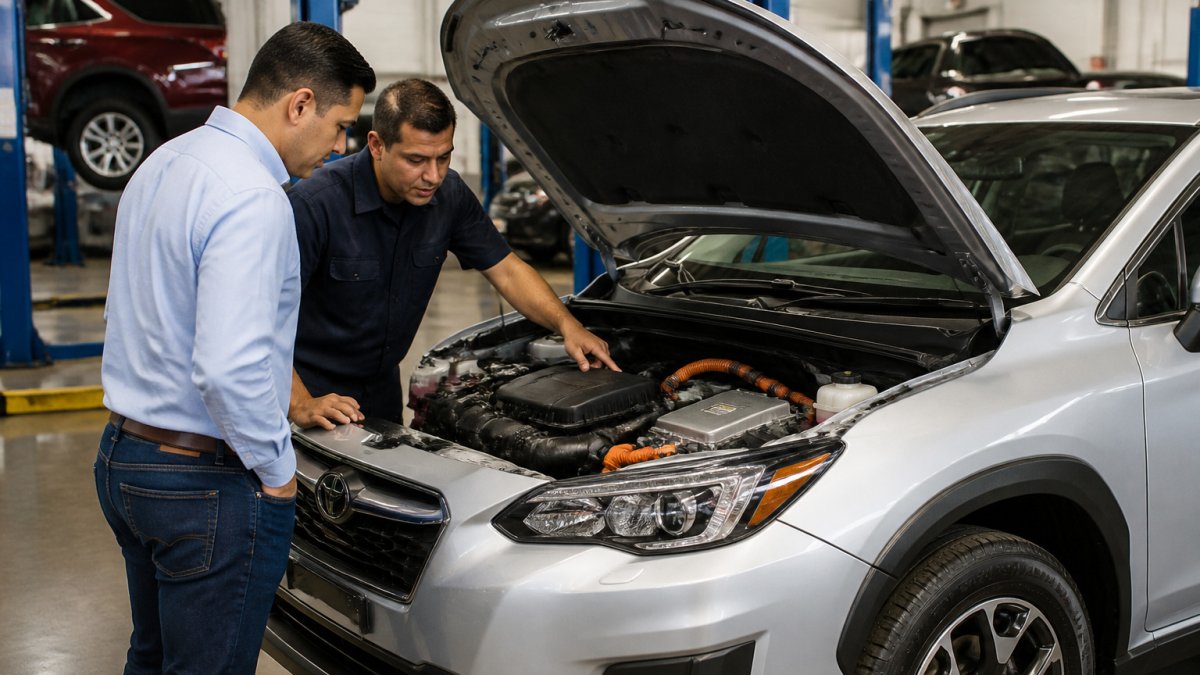
- Have a technician inspect the hybrid battery and cooling system
Deciding Whether a Used Hybrid SUV Fits Your Driving and Budget
Start by listing your monthly budget, typical commute, and how many years you plan to keep the vehicle. Browse the Houston used SUV buying guide for next steps once you have narrowed your options. Then compare two or three specific models using the break-even method above. Carvibe Houston offers a range of pre-owned SUVs, trucks, and sedans along with flexible financing options.
Frequently Asked Questions
What are the downsides of a hybrid SUV?
The main downsides are a higher purchase price than the gas version, a hybrid battery that can be expensive to replace once it ages out of warranty, and more complex powertrain components that require specialized service. Some hybrid SUVs also trade some cargo or towing capacity for efficiency. Weigh these against your expected fuel savings and how long you plan to keep the vehicle. Ask any seller for maintenance records and a battery health report before committing.
What is the lifespan of a used hybrid SUV battery?
Many hybrid SUV batteries are designed to last well over 100,000 miles, and many owners report years of service before any noticeable decline. Battery life depends on climate, charging habits in plug-in models, driving style, and how well the vehicle was maintained. A battery health check at a qualified shop can estimate remaining capacity. Buyers should also confirm whether the original battery warranty is still active, since coverage terms vary by model year and state.
How much does it cost to replace a hybrid SUV battery?
Replacement cost depends heavily on the model, the battery type, and whether you use a new, remanufactured, or refurbished unit. Dealer replacements typically cost more than independent options, and labor adds to the total. Because prices change and vary by vehicle, get written quotes from several shops that service hybrids before buying. Factor a possible replacement into your budget, especially for higher-mileage vehicles without remaining warranty coverage.
What should I check before buying a used hybrid SUV?
Start with a vehicle history report to confirm title status and accident history. Request service records showing hybrid system maintenance and any battery work. Have an independent mechanic perform a pre-purchase inspection, including a scan for hybrid system fault codes and a battery health assessment. Test drive the vehicle to check braking blend, engine start behavior, and any warning lights. Confirm recall status for the specific model year using the NHTSA recall lookup by VIN.