 ultimate-guide
Transparent Used Car Pricing Guide: What You'll Pay
Table of Contents
- Why Transparent Used Car Pricing Matters in 2026
- The Best Used Car Valuation Tools for Accurate Market Value
- Understanding Trade-In Value vs. Private Party Sale
- Hidden Fees in Used Car Buying: A Complete Checklist
- Used Car Price Negotiation Script for Confident Buyers
- How Regional Market Variance Affects Your Final Price
- Post-Purchase Price Verification and Total Cost of Ownership
- Conclusion
- Frequently Asked Questions
Last Updated: September 13, 2026
Why Transparent Used Car Pricing Matters in 2026
Transparent used car pricing means the number you see online is the number you pay at the desk, with every fee disclosed before you commit. At Carvibe Houston, we built our process around that idea because the alternative, opaque pricing, is a common source of buyer frustration.
The Psychology Behind Why Dealers Hide Fees
Hidden fees work because of commitment bias. Once you've test-driven the car, pictured it in your driveway, and told your family about it, walking away over a fee feels like losing the car rather than refusing a bad deal. Dealers know this. That's why the finance office, not the sales floor, is where the real pricing happens.
The fix is simple: demand the out-the-door number in writing before you test drive. A dealership that won't provide it is telling you something.
The Best Used Car Valuation Tools for Accurate Market Value
The most reliable way to find accurate market value is to cross-check at least three independent valuation sources before you ever step onto a lot. No single tool is authoritative, and dealers count on you using just one. The reason is mechanical: each tool samples a different data set, so each one returns a different number.
Here is what each category actually measures, and where it breaks down:
- Instant online valuation tools from major listing sites. These typically blend recent sold data, active listing prices, and auction results. They skew high in hot markets because active listings reflect asking prices, not closed sales. Treat the output as a ceiling, not a target.
- VIN lookup services that decode the build sheet, recall history, and title status. The VIN itself is not a price source, it is an identity source. The build sheet tells you which trim, engine, and packages the car actually left the factory with, which is how you catch a base model being advertised as a higher trim.
- Vehicle history reports from providers like Carfax or AutoCheck, which reveal accidents, odometer readings, and ownership records. These affect value through title brands and reported damage, not through the sticker.
- Regional listing searches to see what comparable vehicles actually sell for near you. This is the only category that captures local supply and demand, and it is the one most buyers skip.
- Auction and wholesale indices, such as the Manheim Used Vehicle Value Index, which track broad price movement over time. Use these to understand whether the market is rising or falling, not to price a single car.
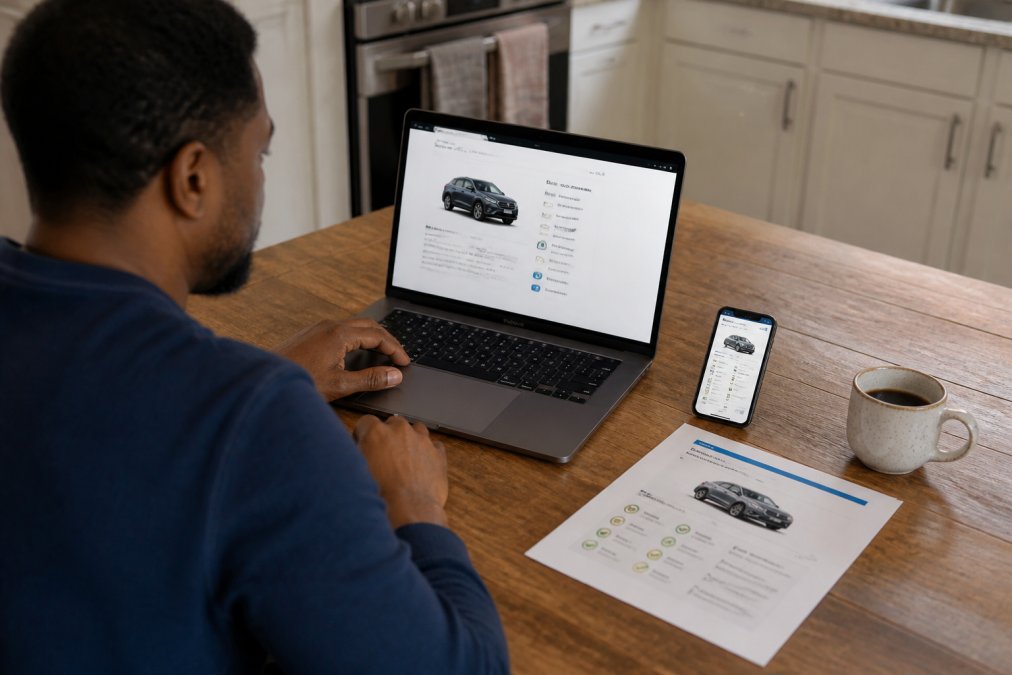
How to Read a Vehicle History Report and VIN Lookup
A vehicle history report is a documented record of a car's past, covering accidents, title brands, odometer readings, and ownership changes. The VIN lookup is how you access it.
What most buyers miss is that history reports have gaps. Not every shop reports to every database, so a clean report is not a guarantee. Use the report to rule cars out, never to rule them in. Pay closest attention to title brands, which flag salvage, flood, or lemon-law buybacks, and to odometer inconsistencies.
How to Reconcile Three Conflicting Valuations
When your three sources disagree, do not average them. Instead, weight them by how close each one is to an actual transaction:
- Start with the regional listing range. This is your anchor, because it reflects what sellers near you are asking right now.
- Adjust down for condition and mileage. A car with above-average miles or a reported accident should sit at the bottom of the range, not the middle.
- Cross-check against the instant valuation tool. If the tool is far above your regional range, the tool is likely sampling a national or hot-market data set. Trust the regional number.
- Discount for title brands. A branded title can cut value substantially, and some lenders will not finance the vehicle at all.
A common pattern is that the instant tool and the regional listings disagree by several thousand dollars on the same vehicle. That spread is not noise, it is the negotiation room, and knowing which number is grounded in local transactions is what separates a prepared buyer from a hopeful one.
Manheim Used Vehicle Value Index
Understanding Trade-In Value vs. Private Party Sale
Trade-in value is what a dealer will pay you for your current car, and it's almost always lower than what you'd get selling privately. That gap is real, but it isn't pure loss.
A private party sale typically nets more money because you're capturing the retail margin yourself. What you give up is time, paperwork, test drives with strangers, and the risk of a bounced payment. A trade-in is faster and often reduces your sales tax liability, since many states tax only the difference between the trade and the new purchase (irs.gov).
Hidden Fees in Used Car Buying: A Complete Checklist
Hidden fees in used car buying are charges added after you've agreed on a price, and they're the most common source of buyer regret. Ask for an itemized out-the-door quote and check it against this list:
- Documentation fee, legitimate but wildly variable; ask what it covers
- Dealer preparation fee, often duplicative of work already done
- Advertising or "market adjustment" fee, pure markup
- Nitrogen tire fill, paint sealant, fabric protection, high-margin add-ons you can decline
- VIN etching, frequently overpriced and sometimes already done
- Extended warranty or gap insurance, negotiable, and never mandatory
- Financing origination fees, compare against your own pre-approved loan
| Fee Type | Negotiable? | What to Do |
|---|---|---|
| Documentation fee | Sometimes | Ask for itemization |
| Dealer prep | Often | Request removal |
| Market adjustment | Yes | Walk away if refused |
| Add-on products | Yes | Decline in writing |
Documentation Fee, Dealer Markup, and Add-Ons to Watch
The documentation fee is the hardest to remove because dealers claim it's a fixed cost. That's sometimes true and sometimes not. What matters is the total, not the line item.
Dealer markup on financing is the quieter problem. A dealer can arrange a loan at a higher interest rate than the bank approved you for and keep the difference (consumerfinance.gov). Get pre-approved through your own bank or credit union first, then let the dealer try to beat it.
Used Car Price Negotiation Script for Confident Buyers
A used car price negotiation script works because it keeps you anchored to data instead of emotion. The script matters less than the sequence: anchor first, justify with data, then let the other side respond before you speak again.
Here is a template you can adapt:
"I've researched this vehicle's fair market range using three valuation sources, and comparable listings in this area are priced between $X and $Y. I'm ready to buy today at $Y out-the-door, including all fees. Can you meet that?"
If the answer is no, ask one question: "What would it take to get there?" Then stay silent. Silence is the most underused negotiation tool there is.
Anchoring, Bracketing, and the Out-the-Door Number
Your first number sets the range for everything that follows. Anchor on the out-the-door figure, never the monthly payment, because the monthly payment is where term length and rate markup hide.
- Anchor low but defensible. Use the bottom of your regional range, not an arbitrary lowball. An anchor you cannot justify gets dismissed.
- Bracket the deal. If you will accept $Y, open at a number below it so the midpoint lands near your target.
- Keep fees inside the anchor. Saying "$Y out-the-door" forces the dealer to absorb documentation and prep fees into the number rather than stacking them on top.
- Never split the difference twice. A single concession is normal. Repeated "meet in the middle" moves mean you are negotiating against yourself.
How to Respond to the Four Most Common Dealer Counters
Most counters fall into a small set of patterns. Prepare a response for each before you walk in:
- "That price is already below market." Ask for the comparable listings they used. If they cannot produce them, restate your regional range.
- "I have to talk to my manager." This is a pressure tactic built on time, not a real obstacle. Say you are happy to wait, and stay quiet when they return.
- "We can hit your payment if we stretch the term." Decline. A longer term lowers the payment and raises the total cost. Ask for the out-the-door price and the financing terms separately.
- "The add-ons are already installed." Ask for them to be removed from the price or the deal. If they refuse, that is information about how the rest of the transaction will go.
When to Walk Away
Walking away is a legitimate outcome, not a failure. If the dealer will not put the out-the-door number in writing, will not itemize fees, or keeps returning to payment instead of price, the deal is not transparent and the numbers will not improve after you sign. A written offer from one dealership is legitimate use at another, so a walk-away is often just a reset with better information.
How Regional Market Variance Affects Your Final Price
The same vehicle can carry meaningfully different prices depending on where it's sold. Regional market variance comes from local supply, demand, and even weather. All-wheel-drive trucks command more in mountain states than in flat, warm ones. Convertibles sell for less in rainy regions.
For buyers in the Greater Houston area, that means a vehicle priced fairly in one suburb may be overpriced in another. Always search listings within a reasonable radius and use that spread as negotiation use.
Post-Purchase Price Verification and Total Cost of Ownership
Post-purchase price verification means confirming, after the sale, that you paid what you agreed and that the financing terms match the contract. Read every line before you sign, and keep a copy of the itemized quote to compare against the final paperwork.
Total cost of ownership goes beyond the sticker: insurance, fuel, maintenance, and depreciation all add up. Certified pre-owned vehicles often carry a higher upfront price but lower risk, since they typically include a manufacturer-backed warranty.
Conclusion
The gap between what a car is advertised for and what you actually pay is where most buyers lose money. Carvibe Houston exists to close that gap, with an inventory of pre-owned SUVs, trucks, and sedans, flexible financing options regardless of credit history, and competitive trade-in values backed by written offers. Our on-site service team keeps your vehicle running long after the sale, and our transparent approach aims to ensure the price you see is the price you pay. Search our inventory and get your out-the-door quote before you visit.
Frequently Asked Questions
What is the $3,000 rule for buying a used car?
The $3,000 rule is a rough guideline some buyers use to estimate the gap between a car's asking price and its fair market value. If a dealer's price exceeds the fair market range from a valuation tool by roughly $3,000 or more, that's a signal to negotiate harder or walk away. It's not a formal standard, but it helps first-time buyers sanity-check transparent used car pricing before signing anything.
Which used car pricing guides are considered the most accurate?
No single guide is perfect, but the best used car valuation tools combine auction data, dealer transaction records, and regional pricing indexes. Cross-reference at least two sources and compare the fair market range they show. If one tool lists a vehicle far below the others, check the odometer reading and condition assessment, since those factors heavily influence wholesale value versus retail value.
What information should you avoid sharing with a car dealer?
Avoid revealing your maximum monthly payment, your exact down payment amount, or that you're financing through the dealership before you've agreed on the vehicle price. Sharing these early gives the dealer negotiation leverage and can lead to dealer markup being buried in financing terms. Focus the conversation on the out-the-door price first, then discuss financing separately.
What are the common hidden fees to look for in a used car contract?
Watch for documentation fees, dealer preparation charges, VIN etching, nitrogen tire fills, and extended warranty add-ons that weren't discussed upfront. Also check for curbstoning red flags if buying from a private seller. Ask for a full itemized fee breakdown in writing before signing, and compare the total against the advertised transaction price to spot any last-minute additions.
This guide is for general informational purposes. Fees, taxes, and financing terms vary by state and lender. Always review your final contract carefully before signing.