 listicle
Reliable Used Trucks for Commuters: 7 Top Picks for 2026
Table of Contents
- Quick Comparison: Top Reliable Used Trucks for Commuters
- 1. 2024 Ford Maverick: The Compact Commuter Champion
- 2. 2020 Ford Ranger: Balanced Midsize Reliability
- 3. 2020 Toyota Tundra: Full-Size Longevity for Daily Driving
- 4. 2025 Chevrolet Colorado: Modern Tech in a Midsize Package
- 5. 2026 RAM 1500: Premium Comfort for the Daily Commute
- 6. 2026 Hyundai Santa Cruz: SUV Comfort with Truck Utility
- 7. 2024 Ford F-150: The Versatile Workhorse
- How to Inspect a Used Truck Before Buying
- Best Used Trucks for Gas Mileage
- Used Truck Maintenance Checklist
- Full-Size vs. Midsize: Which Fits a Commuter?
- Frequently Asked Questions
Last Updated: September 19, 2026
Quick Comparison: Top Reliable Used Trucks for Commuters
Shopping for reliable used trucks for commuters means balancing fuel economy, cabin comfort, and ownership costs against pickup utility. This guide ranks seven proven models for 2026, from compact haulers to full-size workhorses.
| Truck | Body Style | Best For | Watch Out For |
|---|---|---|---|
| 2024 Ford Maverick | Compact | City commuters, tight parking | Low towing capacity |
| 2020 Ford Ranger | Midsize | Balanced utility and size | Basic interior materials |
| 2020 Toyota Tundra | Full-size | Longevity and resale value | Thirsty V8 |
| 2025 Chevrolet Colorado | Midsize | Modern tech on a budget | Higher used asking price |
| 2026 RAM 1500 | Full-size | Ride comfort, long commutes | Hard to park downtown |
| 2026 Hyundai Santa Cruz | Compact | SUV-like daily comfort | Small bed |
| 2024 Ford F-150 | Full-size | Versatile all-rounder | MPG swings by engine |
1. 2024 Ford Maverick: The Compact Commuter Champion
The 2024 Ford Maverick is the best used truck for commuters who want a bed without full-size bulk. Its unibody construction gives it car-like handling, and the available hybrid powertrain delivers the strongest fuel economy in this group. The compact footprint makes city parking easier than a full-size truck, but towing is limited, so skip it if you regularly haul trailers.
- Powertrain: Hybrid option for high MPG
- Handling: Unibody chassis, car-like steering
- Best for: Urban commuters, first-time truck buyers
2. 2020 Ford Ranger: Balanced Midsize Reliability
The 2020 Ford Ranger earns its spot through mechanical reliability and a strong power-to-weight ratio. Its turbocharged engine delivers efficient power without the fuel penalty of a V8, and driver-assist systems came standard on most trims. Don't overlook the transmission fluid service interval on any used truck with unknown history. Cabin materials feel utilitarian, the trade-off for durability over luxury.
3. 2020 Toyota Tundra: Full-Size Longevity for Daily Driving
The 2020 Toyota Tundra is the pick for commuters who prioritize powertrain longevity and resale value. Its V8 has a long track record of high-mileage reliability, and depreciation stays lower than most competitors. Fuel economy is the weak point: if your commute is MPG-sensitive, a smaller truck costs less to run. For buyers who keep vehicles past 150,000 miles, the Tundra's build quality tends to justify the fuel premium.
- Strengths: Engine longevity, resale value, spacious cabin
- Weakness: Lower fuel efficiency than midsize rivals
4. 2025 Chevrolet Colorado: Modern Tech in a Midsize Package
The 2025 Chevrolet Colorado brings updated infotainment, smartphone integration, and Turbo-Max engine options to the midsize segment. It's the newest truck here, so expect a higher used price. Its off-road-capable suspension adds versatility and towing is strong for the class; commuters who want a modern interior and current driver-assist tech should shortlist it.
5. 2026 RAM 1500: Premium Comfort for the Daily Commute
The 2026 RAM 1500 is the comfort leader here, thanks to a coil-spring rear suspension that smooths out rough pavement, with cabin ergonomics and materials at the top of the full-size class. That comfort costs you maneuverability: tight city parking is a genuine daily annoyance, so test a parking garage before you commit. On a 45-minute commute, the ride quality difference is noticeable within the first week.
6. 2026 Hyundai Santa Cruz: SUV Comfort with Truck Utility
The 2026 Hyundai Santa Cruz blends SUV driving dynamics with a small open bed. Car-like handling and a tech-forward dashboard make it one of the easiest trucks to live with daily.
7. 2024 Ford F-150: The Versatile Workhorse
The 2024 Ford F-150 remains the most flexible option, with multiple engine choices including EcoBoost and Pro Power Onboard generator capability, plus a vast dealer network for parts and service. Fuel economy varies significantly by engine, so a pre-purchase inspection and vehicle history report matter more here than on smaller trucks. Payload and towing are class-leading, making it the pick for commuters who also work their truck.
How to Inspect a Used Truck Before Buying
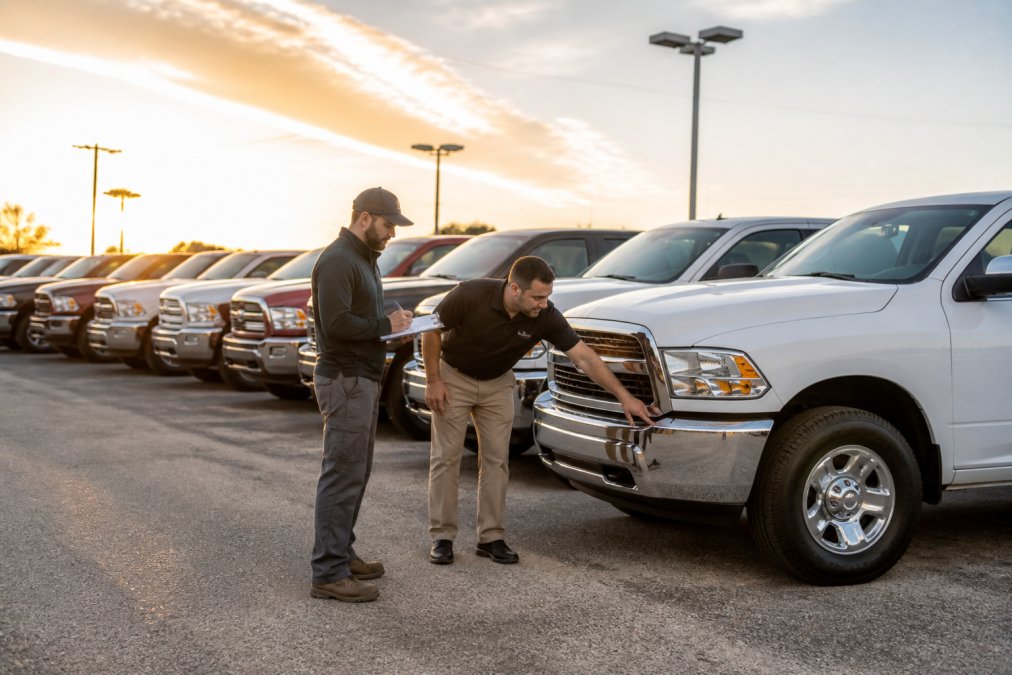
Start with the vehicle history report and a pre-purchase inspection from an independent mechanic, covering the odometer, frame condition, and service records before you discuss price.
Check these items in order:
- Pull the vehicle history report for accident and title records
- Verify the odometer reading against service records
- Inspect the frame and bed for rust or prior repair
- Check transmission fluid color and timing chain service history
- Test every driver-assist system on a highway drive
- Confirm maintenance intervals were followed
- Get an independent pre-purchase inspection
Best Used Trucks for Gas Mileage
Fuel economy is the single largest variable in what a used truck actually costs a commuter, because it compounds every week you own it. Two trucks with the same sticker price can differ by well over a thousand dollars a year in fuel alone. Here is how the picks in this guide stack up:
| Truck | Powertrain | Typical Combined MPG | Fuel Type | Commuter Take |
|---|---|---|---|---|
| 2024 Ford Maverick | Hybrid | Highest in this group | Regular | Best for long highway commutes |
| 2026 Hyundai Santa Cruz | Turbo four-cylinder | Strong for a truck | Regular | SUV-like economy in a truck body |
| 2020 Ford Ranger | Turbocharged four-cylinder | Mid-pack | Regular | Efficient power without a V8 penalty |
| 2025 Chevrolet Colorado | Turbo four-cylinder | Mid-pack | Regular | Newer tech, similar economy to the Ranger |
| 2024 Ford F-150 | EcoBoost V6 | Varies widely by engine | Regular | Pick the EcoBoost, not the V8, for commuting |
| 2026 RAM 1500 | V6 or V8 | Lower than midsize rivals | Regular | Comfort costs you at the pump |
| 2020 Toyota Tundra | V8 | Lowest in this group | Regular | Longevity offsets fuel cost only at high mileage |
How to Estimate Your Real Commute Cost
Rather than trusting the window sticker, run your own math before you buy. The EPA's fueleconomy.gov tool returns combined, city, and highway MPG figures for a specific model year and trim. A simple cost-per-mile estimate:
- Divide your average fuel price by the truck's combined MPG to get cost per mile.
- Multiply that by your daily round-trip commute distance.
- Multiply by your annual commuting days (roughly 250 for a standard five-day schedule).
Hybrid and Electrified Trucks: The Commuter Angle Most Guides Skip
The 2024 Ford Maverick Hybrid is the clearest example of why commuters should look beyond traditional gas powertrains. Its hybrid system pairs a gas engine with an electric motor, recapturing energy during braking and running on electric power at low speeds, exactly the stop-and-go pattern hybrids are built for (How Hybrids Work).
- Battery health matters more than mileage. A hybrid with 80,000 miles and a healthy battery can be a better buy than one with 50,000 miles that sat unused. Ask for a battery state-of-health check as part of your pre-purchase inspection.
- Hybrid systems add complexity, not fragility. The regenerative braking system actually reduces wear on traditional brake pads, which can lower long-term maintenance cost for high-mileage commuters.
Used Truck Maintenance Checklist
A used truck maintenance checklist only earns its keep if it connects to what you will actually spend. Commuters put on steady, predictable miles, so wear items fail on a schedule you can plan for.
What to Inspect Before You Buy
Run these checks in order during your pre-purchase inspection:
- Pull the vehicle history report for accident, title, and odometer records
- Verify the odometer reading against service records and state inspection history
- Inspect the frame, cab corners, and bed for rust or prior collision repair
- Check transmission fluid color and smell; dark or burnt fluid signals deferred service
- Confirm timing chain or belt service history against the manufacturer's interval
- Measure brake pad and rotor thickness
- Inspect suspension, shocks, and ball joints for play or leaking
- Test the battery and charging system
- Check coolant, differential, and transfer case fluid levels
- Test every driver-assist system on a highway drive
What Commuters Should Budget For
Commuter trucks accumulate highway miles, which changes the maintenance profile versus a work truck that idles on job sites: highway miles are gentler on brakes and transmissions but harder on tires and fluids due to sustained heat. The first major expense typically arrives between 60,000 and 100,000 miles. The most frequent items are:
- Tires. A set of truck tires is one of the largest single maintenance costs you will face. Budget for replacement based on tread depth, not just mileage.
- Transmission fluid service. Many manufacturers now specify longer intervals, but a used truck with unknown history is safer with a fresh service.
- Timing chain or belt. On interference engines, a missed interval can mean catastrophic engine damage, so verify this before purchase.
- Brakes. Regenerative braking on hybrid trucks extends pad life; conventional trucks wear pads faster in city driving.
- Suspension components. Shocks and struts typically need attention somewhere past 75,000 miles.
Insurance and Registration Considerations for Personal-Use Trucks
One cost most used-truck guides ignore is insurance. How a truck is classified and used affects your premium: a truck registered and insured for personal commuting is typically rated differently than one used for business, and some insurers ask specifically whether the vehicle is used for work.
Two practical points for commuters:
- Tell your insurer how you actually use the truck. Personal commuting use is generally the cheaper classification, but misrepresenting business use can void a claim.
- Safety features can lower premiums. Automatic emergency braking, blind-spot monitoring, and lane-keeping assist are increasingly standard on newer used trucks, and some insurers offer discounts for them.
Cabin Ergonomics: The Cost You Feel Every Day
Seat condition and cabin noise are not maintenance line items, but they are the costs a commuter notices most. Check seat bolster wear, lumbar support function, and whether the previous owner smoked in the vehicle. On a long commute, a worn driver's seat is a repair you will want to price before you make an offer.
Full-Size vs. Midsize: Which Fits a Commuter?
Midsize trucks win for most commuters: they park easier, burn less fuel, and still handle light towing and payload. Full-size trucks make sense when towing capability or bed length is a genuine weekly need. The deciding question is how often you actually use the bed, a few times a year means a Ranger or Maverick covers it, while regular towing means stepping up to the F-150 or RAM 1500.
Frequently Asked Questions
What is the most dependable used truck to buy?
The 2020 Toyota Tundra is often cited for its long-term durability, with a V8 engine known for high-mileage reliability. Other dependable options include the 2020 Ford Ranger and 2024 Ford F-150, which have strong reliability records. When shopping, check the vehicle history report and get a pre-purchase inspection to confirm condition.
What are the most fuel-efficient used trucks for daily driving?
The 2024 Ford Maverick hybrid offers excellent fuel economy, often exceeding 35 MPG combined. The 2020 Ford Ranger and 2025 Chevrolet Colorado also deliver competitive MPG for midsize trucks. For commuters, prioritize models with smaller engines or hybrid powertrains to reduce fuel costs.
How do you inspect a used truck for reliability before buying?
Start by reviewing the vehicle history report for accidents and service records. Then, perform a thorough visual inspection: check for rust, tire wear, and fluid leaks. Test drive on both city streets and highways, listening for unusual noises. Finally, have a trusted mechanic perform a pre-purchase inspection to catch hidden issues.
What used trucks should commuters stay away from?
Avoid trucks with poor reliability ratings, high maintenance costs, or excessive fuel consumption. Models with known transmission or engine problems, such as certain older Nissan Titans or Dodge Rams, may not be ideal for daily commuting. Also, skip trucks with salvage titles or incomplete service histories.
What is the best truck for everyday commutes?
The best truck for commuting balances comfort, fuel economy, and size. The 2026 Hyundai Santa Cruz and 2024 Ford Maverick are excellent for their car-like handling and efficiency. If you need more space, the 2026 RAM 1500 offers a smooth ride and upscale interior, though it consumes more fuel.