 how-to
How to Verify Used Car Titles: Step-by-Step Guide
Table of Contents
- What You'll Need Before You Start
- How to Verify Used Car Titles Step by Step
- How to Check for a Salvage Title
- Checking for Liens on a Used Car
- How to Spot a Fake Car Title
- Red Flags on a Vehicle Title and the Finance Office Upsell
- Common Mistakes Buyers Make When Verifying Titles
- Frequently Asked Questions
Last Updated: September 10, 2026
What You'll Need Before You Start
Verifying a used car title is the single most important step in any private-party purchase, and it takes less than an hour with the right documents in hand.
Gather these items before you meet the seller:
- The original paper title, not a photocopy
- The seller's government-issued photo ID
- The vehicle's VIN, visible through the windshield on the driver's side
- Your state's motor vehicle department title transfer guide
- A phone or laptop for a paid history report
A common mistake is meeting at night or in a parking lot where you can't read the fine print. Insist on daylight and a flat surface. If the seller resists either, that's your first red flag.
How to Verify Used Car Titles Step by Step
The verification process comes down to three checks: matching the VIN, running a history report, and confirming the seller actually owns the car free and clear. Skip any one of them and you're buying someone else's problem.
Step 1: Match the VIN and Title Details
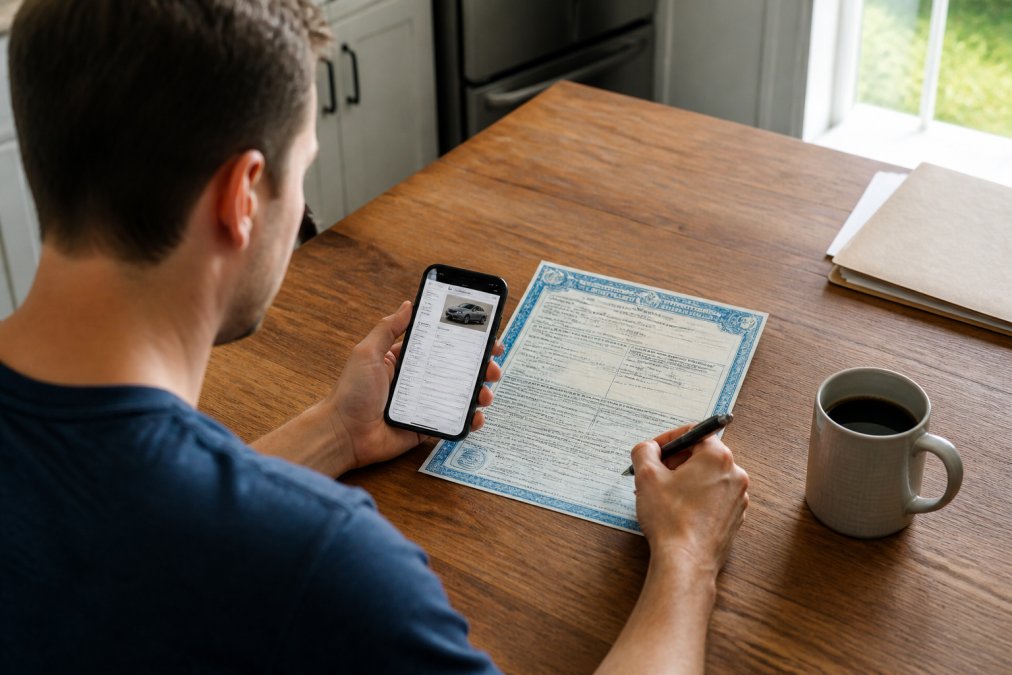
The VIN on the title must match the VIN on the car, character for character. Check all three locations: the dashboard plate, the driver's door jamb sticker, and the title document itself. Any mismatch means walk away. A mismatched VIN often signals a cloned title or a stolen vehicle that's been re-plated.
Also confirm the title is in the seller's legal name. If the name on the title doesn't match the ID in front of you, the seller is either flipping the car without transferring it or selling on someone else's behalf. Both create title transfer headaches you don't want.
Step 2: Run a Title and VIN History Check
A VIN history report shows the vehicle's title events across states: salvage branding, flood damage, odometer rollback, and total loss records. A report costs a modest fee and takes minutes to generate. Use a service that pulls from the National Motor Vehicle Title Information System, which aggregates state title data.
What most guides miss is that history reports aren't perfect. A car salvaged in one state and re-titled in another may show a clean record in the second state if the branding wasn't carried over. Cross-check the report against the physical title's branding section.
Step 3: Confirm the Seller Owns the Car Free and Clear
A clean title with no lien holder listed means the seller owns the car outright. If a bank or lender appears on the title as lien holder, the loan must be paid off and a lien release obtained before you can get a clean title in your name. Never accept a promise that the seller will "handle the lien later." Get the release in writing before money changes hands.
How to Check for a Salvage Title
A salvage title means an insurer declared the vehicle a total loss, typically after a major collision, flood, fire, or theft recovery (peer-reviewed research). The car can still be legal to buy and drive, but the branding follows it for life in most states, drags resale value down sharply, and complicates insurance. The problem is that 'salvage' is not one label, it is a family of brands, and the exact wording varies by state.
The branding categories you will actually see on a title
- Salvage, insurer paid a total-loss claim; the vehicle is not road-legal until repaired and re-inspected.
- Rebuilt / Reconstructed, the vehicle was salvaged, repaired, and passed a state re-inspection. Road-legal, but permanently branded.
- Flood, water damage total loss. Often the most dangerous brand because electrical and corrosion problems surface months later.
- Junk / Non-Repairable, cannot be titled or driven again; parts-only.
- Lemon / Manufacturer Buyback, repurchased under state lemon law; a separate brand from salvage but equally important to catch.
Some states print the brand directly on the face of the title. Others use a color-coded title (for example, a distinct color stock for salvage versus clean) or a separate brand code in the header. Because the format is state-specific, the reliable move is to pull your state motor vehicle agency title brand reference and compare the physical document against the state's own sample.
The NMVTIS lag problem most guides skip
The National Motor Vehicle Title Information System aggregates title data from state agencies, insurers, and salvage yards, but reporting is not instant. A vehicle salvaged and re-titled within a short window can appear clean in NMVTIS for weeks or months before the brand propagates. That is exactly how a rebuilt car gets sold as 'clean' by a seller who knows the timing.
Two defenses:
- Cross-check the physical title's brand field against the history report. If the report shows a salvage event the title does not, trust the report and walk.
- Run the report twice, once before you negotiate and once the day you close. A brand that posts between those two dates is a deal-killer you want to catch before money moves.
How to verify branding state-by-state
Every state motor vehicle agency publishes its title brand definitions and the format it uses. Search '[state] title brand definitions' on the agency site and confirm three things: (a) which brands your state recognizes, (b) whether your state honors another state's brand when a vehicle is re-titled in-state, and (c) whether a rebuilt vehicle requires a re-inspection before it can be registered. Some states carry the out-of-state brand forward automatically; others do not, which is how a flood car from one state can arrive with a clean-looking title in another.
Checking for Liens on a Used Car
A lien is a lender's legal claim on the vehicle until the loan is repaid. You cannot get a clean title while a lien exists, which is why checking for liens on a used car belongs in every deal.
Here's how to check:
- Look at the title's lien holder field. If it's blank, no lien is recorded.
- Request a lien search through your state's motor vehicle agency.
- Ask the seller for a payoff statement from their lender if a lien is listed.
- Confirm the lender sends a lien release directly to the title agency.
The thing nobody tells you about private sales: some sellers take your cash, pay off their loan, and pocket the difference without ever transferring the title. Always complete the transaction at a title office or with a title service that handles the release and transfer simultaneously.
How to Spot a Fake Car Title
Fake titles are more common than most buyers realize, especially in cash private-party deals, and the forgeries have gotten better as printing technology has cheapened. Learning how to spot a fake car title protects you from losing both the car and your money, and from a criminal charge if the title turns out to be stolen.
Physical security features to check on the document
Modern state titles are printed on security stock and carry several features a photocopier or home printer cannot reproduce:
- Intaglio or raised printing, run a fingernail across the state seal and the title number; genuine titles have a tactile raised feel.
- Security watermark, hold the title up to light; a genuine watermark is embedded in the paper, not printed on the surface.
- UV and thermochromic ink, many states print a seal or border element that reacts to heat (rubs away and returns) or shows under a UV light.
- Microprinting, a border or signature line made of tiny text that blurs into a solid line when photocopied.
- Ghost image / void pantograph, a faint background image that reveals the word 'VOID' or 'COPY' when scanned.
- Perforations and serial numbers, many titles have a perforated tear-off or a serial number that must match the state's issued sequence.
Document-level red flags
- Font and spacing inconsistency in the VIN, owner name, or lien holder fields, a sign of a digitally altered template.
- Whiteout, correction fluid, or a pasted-over field anywhere on the face of the title.
- A 'duplicate' title presented when the seller claims the original was lost, legitimate, but it warrants a lien and brand check before you proceed.
- A title from a state the seller has no connection to, especially when the vehicle's registration and inspection history point elsewhere.
- VIN plate rivets, factory VIN plates use specific rivet patterns; replaced or drilled-out rivets often do not match the original.
The digital-vs-physical discrepancy nobody warns you about
This is the modern gap in most title-verification advice. Dealers and private sellers increasingly show buyers a clean digital title record, a screen, a PDF, or an app view, while the physical title carries a brand, a lien, or a correction the digital system has not yet synced. State title databases and NMVTIS update on different schedules, and a digital record can lag the paper document by weeks.
The rule is simple: the physical title is the legal instrument; the digital record is a convenience. Never close a deal on the strength of a screen. Insist on holding the original paper title, compare its brand and lien fields against the history report, and if the two disagree, treat the discrepancy as a stop sign until the state agency confirms which is correct.
Red Flags on a Vehicle Title and the Finance Office Upsell
Certain title problems show up repeatedly, and knowing them saves you from expensive mistakes. Watch for a title in a name that doesn't match the seller, an out-of-state title with no transfer history, a "duplicate" title when the original is claimed lost, or a title with whiteout or correction fluid.
Common Mistakes Buyers Make When Verifying Titles
The same errors sink deals over and over. Avoid these:
- Trusting a photocopy instead of the original title
- Skipping the VIN history report to save a small fee
- Accepting a verbal promise about a lien payoff
- Signing a purchase agreement before reading the itemized bill of sale
- Ignoring state-specific fee caps and paying discretionary fees you don't owe
- Failing to get a signed lien release before handing over cash
Digital vs. physical paperwork discrepancies trip up buyers too. A dealer may show you a clean digital title record while the physical title carries a branding the digital system missed. Always insist on seeing the physical document.
| Mistake | Fix | Impact |
|---|---|---|
| Photocopy instead of original | Demand the physical title | Prevents fake-title fraud |
| Skipping VIN report | Run a full history check | Reveals salvage and liens |
| Verbal lien promise | Get written lien release | Avoids title transfer block |
| Signing before reading | Review itemized bill of sale | Blocks hidden fees |
| Ignoring fee caps | Check state fee limits | Saves discretionary charges |
If you'd rather skip the guesswork entirely, browse our inventory and let our team walk you through the full history report on any car you're considering.
Frequently Asked Questions
Can I verify a car title online for free?
You can run a free VIN check through the National Insurance Crime Bureau's VINCheck tool to see if a car has been reported stolen or salvaged. Many state motor vehicle departments also offer free title status lookups. For a full history including liens, branded titles, and prior accidents, paid services like NMVTIS-approved providers or Carfax give more detail. Always cross-check the physical paper title against the VIN on the car itself.
What are the red flags on a vehicle title?
Watch for a title that lists a different name than the seller, a missing or altered VIN, a branded title (salvage, rebuilt, flood, or lemon), an out-of-state title with no transfer paperwork, or a title marked 'duplicate' with no explanation. Also be wary if the seller refuses to let you photograph the title or insists on meeting in a parking lot instead of a bank or dealership.
What is the difference between a clean and a branded title?
A clean title means the vehicle has no major insurance-reported damage, theft, or lemon history recorded by the state. A branded title carries a permanent notation such as salvage, rebuilt, flood, or lemon. Branded titles usually mean the car was declared a total loss at some point, which lowers resale value and can affect insurance and financing. Always verify the brand on the physical title and through a VIN history report.
How do I check for liens on a used vehicle?
Ask the seller for the title and look for a lienholder name printed on the front. If the title is clear of liens, the seller should be able to hand it over at sale. If a lien exists, the seller must provide a lien release letter from the lender before you take possession. You can also run the VIN through your state DMV or a paid history service to confirm no active lien is recorded.
Verifying a used car title takes an afternoon, but skipping it can cost you the car and your money. Carvibe Houston offers a diverse selection of pre-owned SUVs, trucks, and sedans with flexible financing options regardless of credit history, competitive trade-in values, and full title transparency on every vehicle. Get started with Carvibe Houston and drive away knowing the paperwork is as clean as the car.