 How-to
How to Test Drive a Used SUV: 12-Step Checklist
Last Updated: November 5, 2026
Quick Summary
To learn how to test drive a used SUV, start with the vehicle history report, then follow a repeatable route covering city traffic, highway speeds and tight turns. Walk the exterior, check every seat and warning light, listen for a smooth cold start, and test AWD or 4WD engagement before buying.
- Review the vehicle history report before leaving the lot to catch title problems and accidents.
- Use a 20 to 30 minute route covering stop-and-go traffic, a highway stretch and tight turns.
- Confirm dashboard warning lights go off after startup, and question any that stay on.
- Test AWD or 4WD on a safe, low-traction surface and confirm the indicator stops flashing.
- A test drive cannot reveal engine or frame problems, so get a pre-purchase inspection.
Table of Contents
- Before You Drive: Pre-Test Preparation and Route Planning
- Step 1 to 3: Exterior, Body Panels and Paint Walkaround
- Step 4 to 6: Interior, Seats, Mirrors and Dashboard Warning Lights
- Step 7 to 9: Cold Start, Idle, Noises and Straight-Line Tracking
- SUV-Specific Checks: AWD, 4WD, Drive Modes, Third Row and Cargo
- Used Car Test Drive Checklist and Questions to Ask When Buying a Used SUV
- Arranging a Pre-Purchase Inspection for Used Cars Before You Sign
- Booking Your Test Drive and Next Steps at Carvibe Houston
- Frequently Asked Questions
Before You Drive: Pre-Test Preparation and Route Planning
Buying a used SUV is one of the bigger purchases most families make, and learning how to test drive a used SUV properly is where you find out whether the vehicle is worth your money.
The real goal is simple. You want to know how the SUV looks, feels, sounds and drives under the conditions you actually face every day. That means city traffic, highway speeds, parking and tight turns.
Pull the Vehicle History Report First
Ask for the vehicle history report before you leave the lot, since knowing how to test drive a used SUV well starts with knowing what it has been through. A clean report will not tell you everything, but a bad one should stop you from wasting your time. Look for:
- Title problems, such as salvage, flood or rebuilt branding
- Reported accidents and where the damage was
- Odometer readings that do not match the service records
Ask the seller for the vehicle history report before you visit the lot so you can review it in advance.
Plan a Route That Covers Real Driving
A repeatable route makes your test drive fair. Plan about 20 to 30 minutes and include at least three conditions:
- Stop-and-go traffic to check brakes and transmission behavior at low speed
- A highway stretch to check acceleration, road noise and straight-line tracking
- Tight turns and a parking lot to check steering, visibility and turning radius
Use the same route for every SUV you compare. It is the easiest way to spot real differences between vehicles.
Step 1 to 3: Exterior, Body Panels and Paint Walkaround
Start with a slow walk around the SUV in daylight. Bright, even light shows paint problems and body damage that shadows can hide.
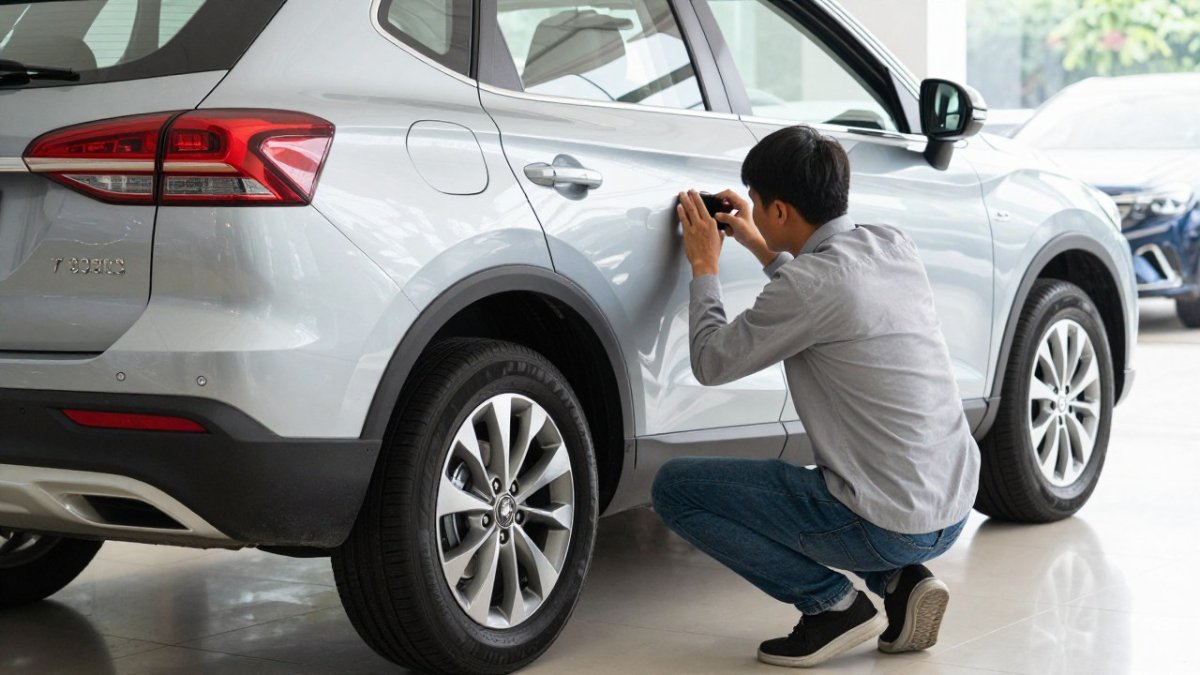
Next, look at the paint from several angles. Mismatched color, overspray on trim or bubbling near edges can signal a repaint.
A common mistake is skipping the underside. Look for fresh fluid drips, heavy rust on the frame, and damage from off-road use.
Step 4 to 6: Interior, Seats, Mirrors and Dashboard Warning Lights
Sit in every seat before you start the engine. Check the front seats for tears, worn bolsters and stiff controls.
Adjust the driver's seat, mirrors and steering wheel until you have a comfortable view.
Turn the key to the "on" position without starting the engine. Watch the dashboard warning lights.
Test the controls too. Press the power windows, locks, climate system, infotainment screen and cruise control.
Step 7 to 9: Cold Start, Idle, Noises and Straight-Line Tracking
Ask the seller not to warm up the engine before you arrive.
Once the engine runs, let it idle and listen again. A steady, smooth idle is what you want. Shaking, surging or a rattle from under the hood needs an explanation.
Start driving slowly and listen for unusual noises. Common ones include:
- Grinding or squealing when you brake
- Clunking over bumps, which can point to worn suspension parts
- Whining or humming that changes with speed
On a straight, flat road, let go of the steering wheel for a moment at a safe speed. The SUV should track straight without pulling hard to one side.
SUV-Specific Checks: AWD, 4WD, Drive Modes, Third Row and Cargo
SUVs are bought for capability and family use, so test those functions directly instead of assuming they work.
AWD and 4WD: Know What You Are Testing
First, identify the system from the owner's manual and the badge. Full-time AWD is always engaged and needs no driver input.
Test procedure on a safe, low-traction surface such as a gravel lot or wet grass, never on dry pavement with a part-time system:
- Shift into 4H at a stop or at very low speed as the manual directs, and confirm the indicator light stops flashing and stays solid.
- Drive a few slow figure-eights and listen for binding, clunking or tire scrub. A part-time system that binds in tight turns on dry ground is behaving normally; one that clunks or refuses to engage is not.
- If the vehicle has 4L, engage it only per the manual (usually stopped, in neutral) and confirm it engages and disengages without grinding.
Watch out: a flashing or illuminated 4WD/AWD light after engagement can indicate a failed actuator, a bad wheel-speed sensor or a transfer-case fault, any of which can be a four-figure repair, so treat it as a stop-and-diagnose item rather than a quirk.
Drive Modes and Throttle Response
Cycle through every mode the SUV offers, typically eco, normal, sport, snow, mud/ruts and, on some models, a tow/haul setting. In each mode, accelerate from a stop and at mid-throttle and note whether the transmission holds gears longer, shifts earlier or feels harsh. A sport mode that slurs shifts or an eco mode that hesitates badly can point to a transmission or software issue.
Third Row, Child Seats and Cargo
Bring the car seats and stroller you actually use. Fit the child seat in the second row and, if you will use it, the third row, and check that the seatbelt and LATCH anchors are reachable and undamaged.
Load the cargo area with a suitcase or stroller and check the liftover height, the width between wheel wells, and whether the cargo cover or floor panels sit flat.
Hybrid and Electric SUV Checks
On a hybrid, watch the dashboard energy-flow display during a slow start and light acceleration to confirm the gas engine shuts off and restarts smoothly, and feel for a shudder during the transition. Test regenerative braking by lifting off the accelerator at low speed, the drag should be smooth and consistent, and the friction brakes should engage without a grab or lurch at the end of a stop.
Used Car Test Drive Checklist and Questions to Ask When Buying a Used SUV
Use this quick checklist after each drive:
- Clean history report reviewed
- Body panels and paint look consistent
- All seats, mirrors and controls work
Then ask the seller a few direct questions: Compare affordable used vehicles in Houston to see what other options fit your budget.
- Has the vehicle ever been in an accident, and where was the damage?
- Who owned it before, and how was it used?
- Are there service records, and when was the last oil change?
Use these checks after each drive to see how the SUV measures up.
| Check | What to look for | Why it matters |
|---|---|---|
| Vehicle history report | Title problems, accidents, odometer gaps | A bad report should stop you early |
| Test route | Stop-and-go, highway, tight turns | Gives a fair comparison between vehicles |
| Dashboard warning lights | Any light that stays on | Points to problems to ask about |
| Cold start and idle | Smooth start, steady idle | Hidden problems show up before the engine warms |
| Straight-line tracking | No pulling or wandering | Signals steering or alignment issues |
| AWD or 4WD engagement | Indicator solid, no binding or clunking | Confirms the system works as designed |
| Third row and cargo | Fits your seats and gear | Confirms the SUV suits your family needs |
Arranging a Pre-Purchase Inspection for Used Cars Before You Sign
A test drive tells you how the SUV feels, but it does not reveal what is happening inside the engine, transmission, transfer case or frame. Before you finalize the purchase, learn how to get auto loan pre-approval in Houston in seven steps so you know your budget. A pre-purchase inspection (PPI) by an independent mechanic can cover those areas.
What a Drive Cannot Reveal
A 20-minute drive will not show you compression loss, a failing head gasket, worn timing components, a cracked frame weld, a leaking differential seal, or the true depth of rust on a unibody or ladder frame. It also will not show you stored diagnostic trouble codes that were recently cleared, airbag deployment history, or prior structural repair hidden under fresh undercoating.
When to Schedule It
Arrange the PPI after your test drive and before you negotiate a final price, not after you sign. If the seller will not allow an independent inspection at a shop of your choosing, treat that as a serious warning sign and walk away. Professional mechanics will perform a thorough assessment, but you should also familiarize yourself with the essential inspection checks to identify potential mechanical red flags before the vehicle ever reaches the service bay.
What to Ask the Shop to Cover
Ask for a written report that includes:
- A scan for stored and pending diagnostic trouble codes, plus readiness monitors
- Compression or cylinder-balance testing where the shop recommends it
- A lift inspection of the frame, subframe, suspension, exhaust, brake lines and fuel lines
Expect to pay for the inspection, and confirm the cost with the shop before you book it. Ask the shop to note anything that is a safety issue versus a maintenance item, so you can separate deal-breakers from negotiation points.
Using the Report
Compare the report line by line with what you observed on the drive. If the mechanic finds a problem you missed, that is not a reason to abandon the SUV automatically, it is leverage. Get a written repair estimate and either ask the seller to address it or subtract it from your offer. If the report shows structural damage, flood evidence or a major driveline fault, walk away.
Booking Your Test Drive and Next Steps at Carvibe Houston
Ready to put this checklist to use? Search the used SUV inventory online to see which models fit your budget and daily needs. Before you commit, review auto financing options in Houston so you know what you can afford. Bring this checklist along to any test drive and take your time with each step.
Frequently Asked Questions
What is the best way to test drive a used car?
Plan a route of about 30 to 45 minutes that mixes city streets, a highway stretch at 60 to 70 mph, a parking lot for low-speed turning, and a bumpy or uneven road if you can find one. Drive the same loop with the radio off so you can hear the engine, brakes and suspension. Keep a written scorecard and rate each item as you go, rather than relying on memory after you return to the lot. Bring a second person if possible so one of you can focus on the dashboard and noises.
Should I take a used SUV to a mechanic for a pre-purchase inspection?
Yes. A test drive shows how the vehicle feels, but it cannot reveal hidden problems such as frame damage, fluid leaks, worn suspension bushings or an aging timing belt. An independent mechanic can put the SUV on a lift and read diagnostic codes, typically for a fee you pay directly to the shop. Ask the seller in advance whether the inspection is allowed, and schedule it before you agree to a price. A failed or refused inspection is a strong signal to walk away.
What specific mechanical sounds should I listen for during an SUV test drive?
Listen for knocking or ticking that changes with engine speed, which can point to valve or lifter issues. Grinding or squealing when braking suggests worn pads or rotors. Clunks over bumps often mean worn suspension components such as struts, sway bar links or ball joints. A whining or humming that rises with vehicle speed can indicate a wheel bearing or differential problem, and a shudder during gear changes can signal transmission trouble. Note when each sound happens, such as cold start, acceleration or turning.
Is it necessary to test drive an SUV on both highways and local roads?
Yes. Highway driving reveals vibration at speed, wind noise, steering stability and how the transmission behaves at steady throttle. Local roads expose low-speed braking, stop-and-go transmission behavior, parking maneuvers and suspension noise over potholes and speed bumps. An SUV can feel very different loaded or unloaded, so if you plan to carry passengers or cargo, test it with a similar load where possible.